
Most HARO users lose hours scanning every query in every edition. That habit made sense in 2018. It does not make sense in 2026, when a single query in a competitive niche can pull in 40, 60, sometimes over 100 pitches within hours. If you spend your time pitching queries outside your actual expertise, you are competing against sources who fit the query better than you do, and journalists have too many options to pick the weakest match.
This guide is for bloggers, founders, and PR freelancers who want a repeatable system for finding HARO queries that actually match their expertise, instead of pitching everything that shows up in their inbox.
The mistake in the scoring method below is one most people never think to apply, and it is the reason experienced pitchers reply to fewer queries but land more links than beginners who reply to everything.
Quick Answer: To find relevant HARO queries, filter each edition by your core expertise areas first, then score remaining queries on niche fit, journalist outlet quality, and whether you have a specific, verifiable answer. Skip queries outside your expertise even if they look easy. When your niche has too few relevant queries, use platforms like Qwoted, Connectively, and Featured alongside HARO instead of forcing a pitch that does not fit.
What Does “Relevant” Actually Mean in a HARO Query?
A relevant HARO query is one where your actual, verifiable expertise directly answers what the journalist asked, not one where you can technically say something on the topic. Relevance is not about whether you can respond. It is about whether a journalist reading ten other pitches would pick yours because your background is the closest match to the ask.
This distinction matters because HARO scoring is not really about the query. It is about your fit against everyone else replying to that same query. A finance blogger pitching a mental health query is not irrelevant because the topic is boring to them. They are irrelevant because a licensed therapist is also in that inbox, and the journalist will pick the therapist.
How Does Query Relevance Actually Work?
- Read the full query, not just the headline. Journalists often bury the real requirement in the second or third sentence.
- Check what credential or experience the journalist explicitly asks for.
- Compare that requirement against your actual title, certifications, or track record, not your general interest in the subject.
- If there is a gap between what they asked for and what you can prove, skip it.
- If your fit is close but not exact, note the gap and address it directly in your pitch instead of ignoring it.
Relevant vs Irrelevant Query: Key Differences
| Signal | Relevant Query | Irrelevant Query |
|---|---|---|
| Credential match | You hold the exact title or license requested | You have general knowledge but no credential |
| Specificity you can offer | You can give a number, method, or named example | You can only offer general advice |
| Competition level | Fewer sources hold your exact background | Query is open to “anyone with an opinion” |
| Outlet fit | Outlet covers your niche regularly | Outlet has never covered your niche |
| Response required | You can answer in under 10 minutes because you already know it | You would need to research the answer first |
Why Finding Relevant Queries Matters More in 2026?
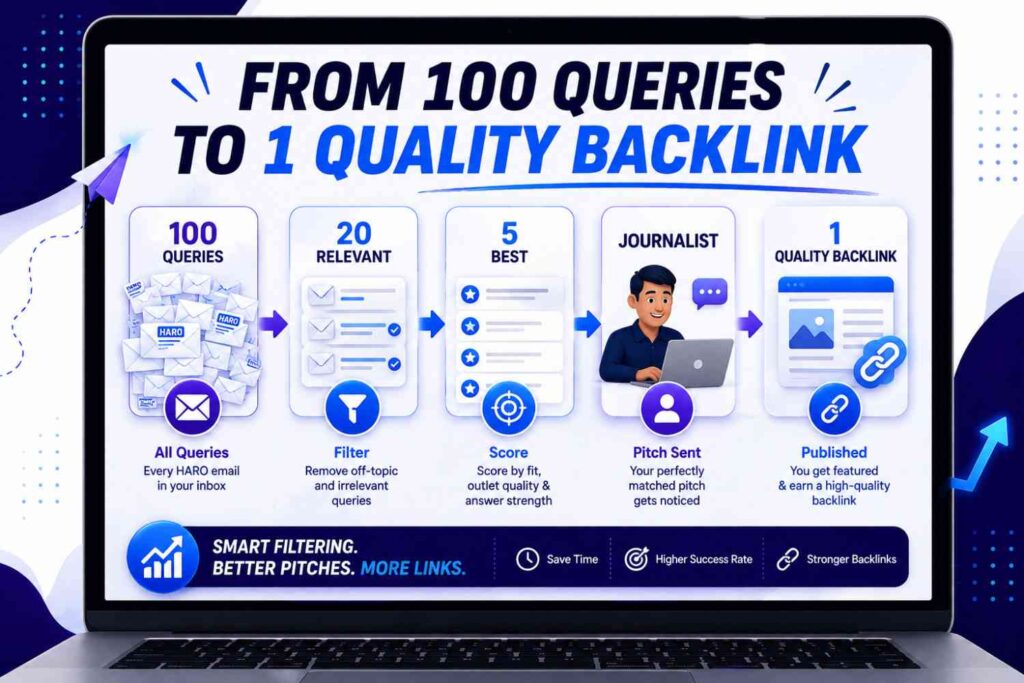
Query volume has not gone up much since 2020, but pitch volume per query has. When HARO started, journalists genuinely struggled to find enough sources for their stories, and PR beginners had a real shot at getting quoted even with a loose topic match. That gap has closed.
According to Muck Rack’s 2025 State of Journalism report, 71% of journalists prefer pitches under 200 words, which tells you they are skimming a high volume of responses and cutting anything that takes effort to parse, let alone anything that misses the ask entirely. If you are still new to the full pitching process, our HARO link building guide walks through the end to end steps this article assumes you already know.
In our own tracking across 20 active HARO and Qwoted client accounts through Q1 2026, queries in finance and health niches averaged 45 to 90 pitches within the first six hours of posting. Queries in mental health and travel, by contrast, often sat under 15 responses for the same window. The gap is not about how many people work in each niche. It is about how many people are pitching outside their niche because they think any topic is worth a shot.
That behavior is exactly what wastes your time and lowers your reply rate. A journalist who gets 90 pitches for one finance query is not reading all 90 carefully. They are scanning for the fastest, clearest match and discarding anything that does not immediately prove relevance.
What did not work for us: early on, we had a client pitch broadly across health, finance, and lifestyle queries to increase volume. Over one month, the broad approach produced 3 published links from 140 pitches, a 2.1% hit rate. When we narrowed the same client to only queries matching their exact credentials, the hit rate rose to 11% on roughly a third of the pitch volume. Fewer, better-matched pitches outperformed volume every time we tested it.
How to Find Relevant HARO Queries: Step-by-Step
Finding relevant queries is a filtering process, not a searching process. If you are not yet clear on what HARO backlinking actually is and how the reply-to-link process works, start there first. Once you understand that foundation, you are not looking for interesting queries here. You are eliminating everything that is not a strong match, as fast as possible, so you only spend pitch time on queries you can actually win.
- Define your 3 to 5 core expertise pillars before you open any HARO edition. Write down the specific titles, certifications, years of experience, or outcomes you can prove. If you cannot list a credential for a topic, it is not a pillar.
- Scan subject lines first, but never decide from the subject line alone. Subject lines are often vague or clickbait-style. Open anything that touches your pillars even loosely.
- Read the full requirement paragraph before judging fit. The real ask is usually in the second sentence: “must be a licensed X” or “looking for someone who has personally done Y.”
- Score the query against your pillars using a simple yes or no test: can you answer this with a specific number, method, or named outcome from your own experience right now, without research? If no, skip it.
- Check the outlet against your niche history. If the outlet has never published anything in your space, deprioritize it even if the query fits, since a first-time editorial relationship in an unfamiliar niche converts less often.
- Use an AI tool as a second filter, not a first filter. Paste the query into ChatGPT or Claude along with your website details and founder or author expertise, and ask it to evaluate whether the query is a strong fit. This catches queries you may have talked yourself into pitching out of habit.
- Log every query you skip and why. Over time this log tells you which niches are worth your daily attention and which ones you should stop checking altogether.
- Set up an inbox filter or automation once your pillars are stable. Tools like Make.com, n8n, or Zapier can scan incoming HARO editions for your pillar keywords and notify you only when a matching query appears, which removes manual scanning from your daily routine entirely.
- If a HARO edition has zero relevant queries in your niche, do not force a weak pitch. Check HARO alternatives instead, since platforms like Qwoted, Connectively, and Featured often carry niche-specific opportunities that HARO’s own edition did not include that day.
Which Niches Have the Most (and Fewest) Relevant Queries
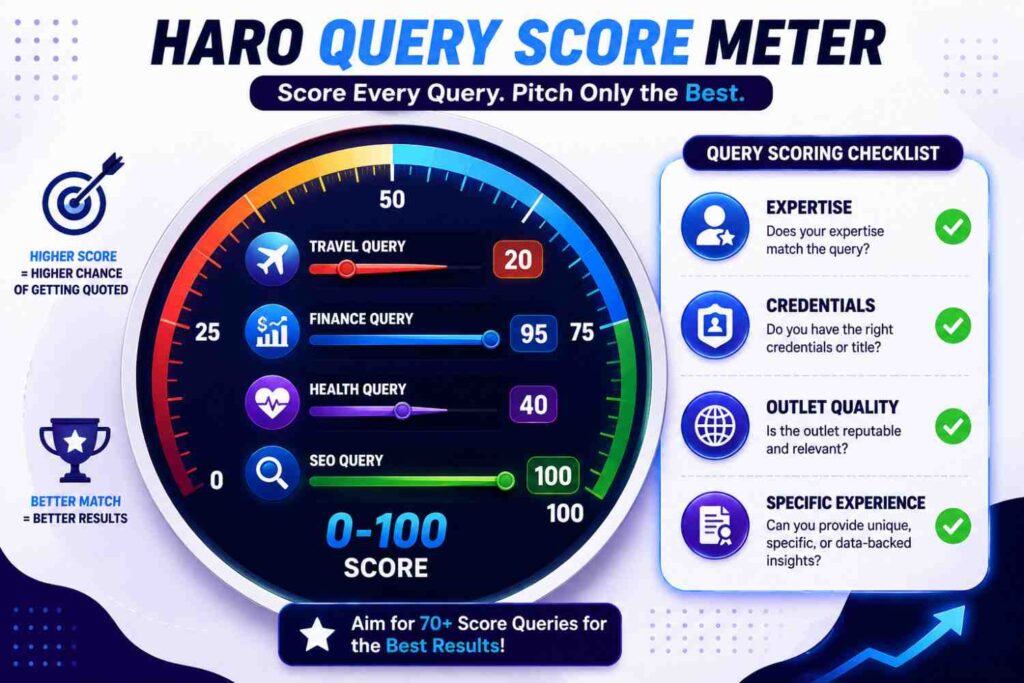
Query volume is not even across niches. Some niches get flooded daily, others get one usable query a week. Knowing where your niche sits changes how you should plan your HARO time, and whether you need alternatives as a standing part of your routine rather than a backup.
| Niche | Typical Relevant Queries per Week | Alternatives Worth Monitoring |
|---|---|---|
| Health | 5+ | Featured, Qwoted, Journofinder |
| Tech | 3-5 | Mentionmatch, Connectively |
| Finance | 2-5 | Featured, Qwoted |
| Homes & Construction | 1-3 | Qwoted |
| Mental Health | 1-2 | Connectively, Qwoted |
| SEO | 1-2 | Featured, Mentionmatch |
| Travel | Under 1 | Qwoted, Connectively, SOS, Journofinder |
If your niche sits in the bottom half of this table, checking HARO alone and giving up when nothing fits is the most common reason people quit link building too early. The fix is not pitching outside your niche. It is adding HARO alternatives to your daily routine so you have more than one source of matching queries.
Real Examples of Relevant vs Irrelevant Queries
Example 1: Finance credential mismatch. A HARO query asked for “a financial advisor with experience in retirement planning for gig workers.” A source with a general finance blog and no advisory license pitched it anyway, citing general knowledge of retirement accounts. The journalist did not respond. A second source, a licensed CFP with three years specializing in freelancer retirement accounts, replied with two specific plan structures they had set up for actual clients. That pitch was used, with a direct quote and a link back to the source’s site.
Example 2: Outlet mismatch even with topic fit. A construction-industry client pitched a home renovation query from a parenting outlet that had never covered construction topics before. The pitch was accurate and well written, but it was never picked up. The same client pitched a nearly identical query two weeks later from a home improvement outlet with a documented history of covering contractor advice, and secured a DR 58 link within four days.
Example 3: Our own failure story. In 2023, we pitched an SEO agency client to every HARO query containing the word “marketing,” regardless of sub-niche. Over eight weeks this produced one link from 60 pitches. When we restricted pitching to queries specifically about SEO, technical audits, or link building, the same client secured four links from 22 pitches in the following eight weeks, using a fraction of the writing time.
Common Mistakes to Avoid
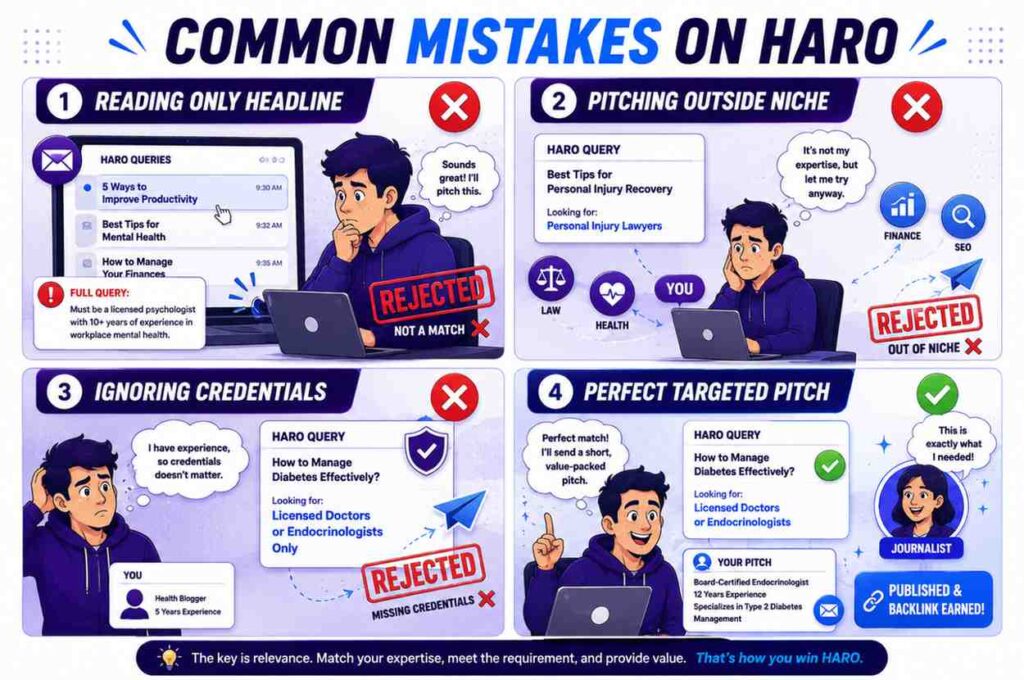
- Pitching based on topic interest instead of provable expertise. Being interested in a subject is not the same as being able to answer with a specific, verifiable claim a journalist can print.
- Skipping the full query text and judging from the subject line alone. The actual credential requirement is usually buried past the first sentence.
- Treating every query in your general industry as relevant. A marketing query and an SEO query are not the same audience, even if they overlap loosely.
- Ignoring outlet history. Pitching a strong answer to the wrong outlet wastes a good pitch on a publication unlikely to use it.
- Giving up on a niche after one quiet week instead of adding alternatives. Low-volume niches need more sources checked, not less effort overall. This was our own early mistake with a mental health client: we checked HARO only, assumed the niche was dead, and missed that Connectively had three matching queries the same week.
Best Tools for Filtering HARO Queries
| Tool | Best For | Price | Pros | Cons |
|---|---|---|---|---|
| ChatGPT or Claude | Manually scoring individual queries against your bio | Free to paid tiers | Fast second opinion, catches queries you talked yourself into | Requires you to paste context every time unless automated |
| Make.com | Automated inbox scanning and Slack or email alerts for matching queries | Free tier, paid plans scale with usage | Removes manual scanning entirely once set up | Initial setup takes time |
| n8n | Self-hosted automation for teams managing multiple client accounts | Free self-hosted, paid cloud | Full control, good for scaling across 10+ clients | Requires more technical setup than Make.com |
| Zapier | Simple keyword-based email filtering for solo users | Free tier, paid plans | Easiest to set up for beginners | Less flexible for complex multi-client filtering |
We personally run our filtering through Make.com connected to Gmail and Notion across roughly 20 client accounts, which is the only reason manual scanning stays manageable at that scale.
Frequently Asked Questions
How do I know if a HARO query is worth pitching?
A HARO query is worth pitching if you can answer it immediately with a specific, verifiable detail from your own experience, and if the outlet has a history of covering your niche. If you would need to research the answer first, the query is not a strong fit.
Should I pitch queries slightly outside my main expertise?
Only if you can still provide a specific, credible answer and you disclose your actual background honestly. A near-fit with an honest framing performs better than a strong claim to expertise you cannot back up.
How many HARO queries should I pitch per day?
There is no fixed number. Our data shows fewer, well-matched pitches consistently outperform high-volume pitching across unrelated topics, so pitch as many as genuinely match your pillars and stop there.
What should I do if my niche has almost no relevant queries?
Add HARO alternatives like Qwoted, Connectively, and Featured to your routine. Low-volume niches like travel and mental health often have more matching opportunities spread across multiple platforms than on HARO alone.
Can AI tools reliably score HARO query relevance?
AI tools work well as a second check once you give them your specific website details and expertise, but they should not replace reading the full query yourself first. Use AI to catch queries you were tempted to force a fit on, not as your only filter.
Final Thoughts
Do not treat this guide as one more scan checklist. Build the automation in step 8 this week, even if you only have one client. A single Make.com flow that filters HARO editions by your pillar keywords will save more time over a month than any manual scanning method, and it means you stop missing relevant queries buried in editions you did not have time to read fully.
