
By Muhammad Ahmad Khan, HARO and Digital PR Expert
HARO link building is one of the most talked-about strategies in SEO, and also one of the most misunderstood. I have been doing this since 2020. I have written thousands of pitches, secured hundreds of placements on Forbes, Entrepreneur, Yahoo Finance, and USA Today, and watched this entire landscape change in ways that most people writing about HARO have never actually experienced.
This guide covers what HARO really is, how it worked when I started, how it works in 2026, and most importantly, whether it is actually worth your time based on where you stand as an expert.
Who this guide is for: Bloggers, startup founders, small business owners, and SEO beginners who want to understand HARO link building before investing time or money into it.
What is HARO Link Building?
HARO link building is the process of responding to journalists’ queries to earn editorial backlinks from high-authority publications. A journalist posts a request for an expert source. You send a pitch. If the journalist uses your quote or insight, they include your name and a link to your website in their published article.
The links earned this way are called earned media backlinks. They are among the most powerful links in SEO because they come from real editorial decisions, not paid placements or link exchanges.
HARO stood for Help a Reporter Out. The platform was founded by Peter Shankman in 2008, later acquired by Cision, rebranded as Connectively in 2023, and officially shut down in April 2024. In 2026, it launched back with the old interface and domain name. The strategy itself, which is pitching journalists for backlinks, is fully alive through a growing list of alternatives covered later in this guide.
How HARO Originally Worked?
When HARO was active, the process was straightforward:
- Sign up as a source on the HARO platform (free tier available)
- Receive three email digests per day: morning, afternoon, and evening
- Browse journalist queries organized by category, such as business, tech, finance, and health
- Identify queries relevant to your expertise
- Write and send a pitch to the journalist’s anonymous HARO email address
- Wait for a response and, if selected, receive a mention with a backlink in the published article
The system was simple and effective. A journalist needed an expert source. You provided one. Both parties benefited without any money changing hands.
HARO Then vs Now: What Changed Between 2020 and 2026?
This is the section that most HARO guides skip entirely because most people writing about HARO have never actually used it consistently over multiple years.
I started running HARO campaigns in 2020. The platform felt completely different back then.
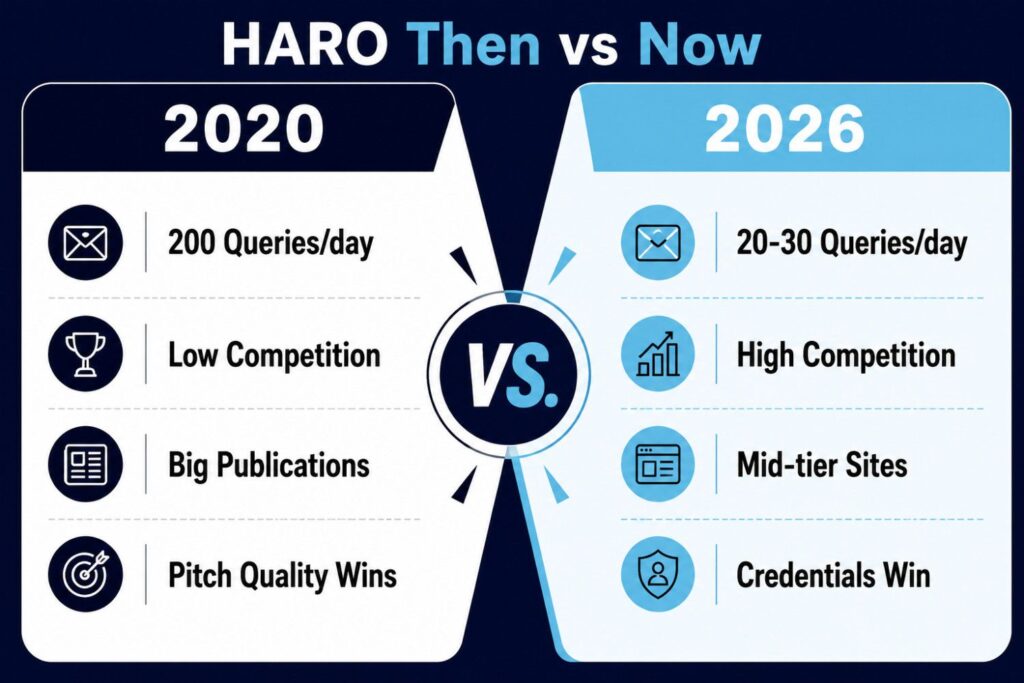
In 2020, each HARO edition contained around 200 queries. Hundreds of journalists from major publications, including Forbes, Business Insider, Bloomberg, and The New York Times, were actively posting requests. Competition was relatively low because fewer marketers knew about HARO as an SEO strategy. Response rates were significantly higher. You could win placements based on the quality of your pitch alone.
By 2026, the picture is very different. Most queries come from newer or smaller publications. The big-name journalists have largely moved away from these platforms. AI tools have made it easy for people to send pitches at scale, so journalists receive far more responses than before. This spike in volume has pushed response rates down sharply.
HARO 2020 vs 2026 Comparison
| Factor | HARO in 2020 | HARO-Style Platforms in 2026 |
|---|---|---|
| Queries per edition | Around 200 | 20 to 30 on average |
| Journalist quality | Many from Forbes, NYT, Business Insider | Mostly newer or mid-tier publications |
| Pitches received per query | Low (fewer people knew the strategy) | Very high (AI tools increased volume) |
| Average response rate | High | Low to moderate |
| Win rate for non-experts | Moderate | Low |
| Win rate for certified experts | High | Still high |
| Best winning factor | Quality pitch plus relevant expertise | Verified credentials plus targeted expertise |
The conclusion from this comparison is important. The strategy still works. But the rules have changed significantly, and ignoring that change is the biggest mistake most newcomers make.
Why HARO Backlinks Are So Powerful for SEO?
Before getting into what works today, it helps to understand why people pursue HARO link building in the first place.
A backlink from Forbes, Entrepreneur, or Healthline carries enormous weight in Google’s algorithm. These sites have Domain Authority scores above 80 or even 90, millions of pages of trusted content, and editorial standards that Google recognizes and rewards consistently.
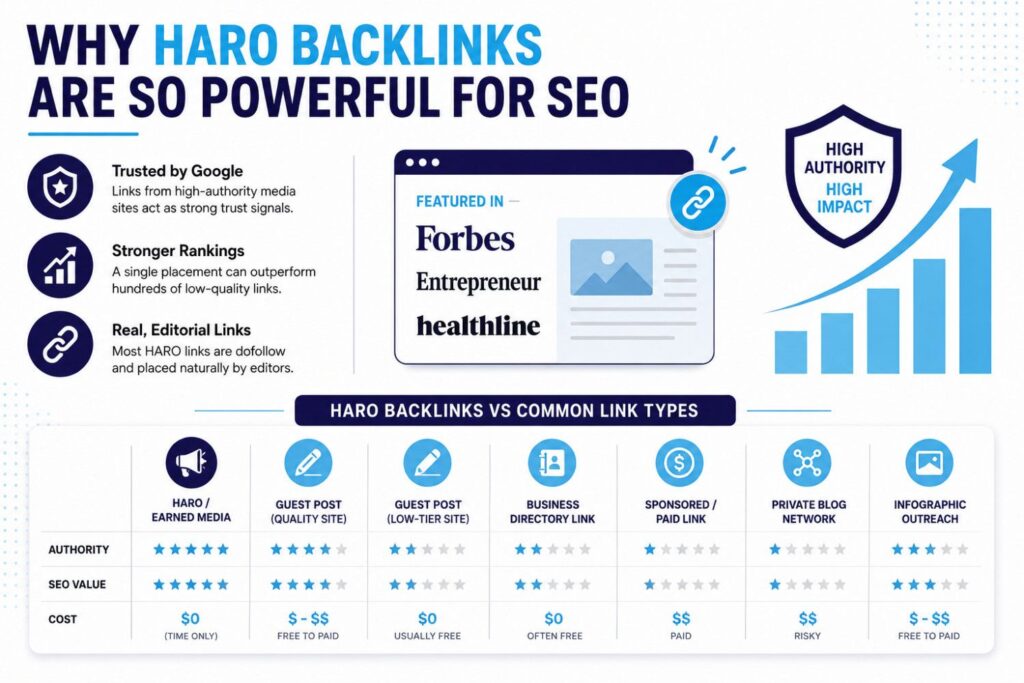
When a site like Forbes links to your website, Google interprets that as a strong vote of confidence. One placement on Forbes can move the needle more than hundreds of links from low-authority directories or blog networks. These are also dofollow editorial links in most cases, meaning they pass link equity directly to your domain.
HARO Backlinks vs Common Link Types
| Link Type | Typical Domain Authority | Editorial Nature | SEO Value | Cost |
|---|---|---|---|---|
| HARO or Earned Media | 70 to 95 | Yes | Very High | Free (time only) |
| Guest Post (quality site) | 40 to 70 | Partial | Medium to High | Free to paid |
| Guest Post (low-tier site) | 20 to 40 | Partial | Low | Usually free |
| Business Directory Link | 15 to 40 | No | Low | Often free |
| Sponsored or Paid Link | Variable | No | Low (usually nofollow) | Paid |
| Private Blog Network | Low | No | Risk of penalty | Paid |
| Infographic Outreach | 40 to 70 | Partial | Medium | Free to paid |
Real Results: Two Campaign Case Studies
Theory only goes so far. Here are two real campaigns I have managed to show what consistent HARO link building actually produces over time. Both clients started with low or zero domain authority. Both achieved significant organic growth through earned media placements alone, with no paid advertising involved.
Campaign Results at a Glance
| Metric | Client A: Health and Wellness | Client B: Family and Lifestyle |
| Campaign Duration | 2+ years (ongoing) | Ongoing |
| Domain Rating | 0 to 29 | 0 to 32 |
| Monthly Traffic | 30 to 3,000 visitors | 0 to 7,000 visitors |
| Keywords Ranking | 350 to 1,600 | 0 to 8,000+ |
| Editorial Placements | 9 major publications | 30+ editorial placements |
Client A: Health and Wellness Brand
Client A runs a health and wellness brand competing in one of the most credential-strict niches in earned media. Publications like Healthline, Verywell Mind, and Psych Central have editorial standards that rival academic journals when it comes to sourcing. When the campaign started, the site had just 30 monthly visitors, a domain rating of zero, and 350 keywords ranking in positions too low to drive any traffic.
The strategy focused exclusively on health, wellness, and mental health query categories. Every single pitch led with the client’s verified credentials and included specific clinical insights rather than generic observations. We were disciplined about rejecting any query that was not a strong match for the client’s exact expertise.
Over two-plus years of consistent outreach, the results compounded. The site now receives 3,000 monthly visitors, ranks for 1,600 keywords, and has earned editorial placements on Forbes, HuffPost, Healthline, Verywell Mind, PopSugar Health, Psych Central, Yahoo, Parade, and Care.com.
| Key Lesson from Client A: – Healthline and Verywell Mind are among the most credential-strict publications in earned media outreach – Every single placement required leading with verified credentials in the very first line of the pitch – Traffic growth from 30 to 3,000 monthly visitors happened with zero paid advertising – Health is a high-effort, high-reward niche. Clear the credential barrier, and the placements follow.w |
Client B: Family and Lifestyle Brand
Client B launched a family and lifestyle brand with zero online presence. No traffic. No keyword ranking. Domain rating of zero. The site was new with no existing backlink profile and no prior SEO investment.
Unlike Client A, this campaign did not require specialist medical or legal credentials. The query categories covered parenting, family, lifestyle, and general business across multiple platforms. The strategy shifted to volume and speed, pitching every relevant query quickly and iterating on pitch structure based on what was working.
The site now attracts 7,000 monthly visitors, ranks for 8,000+ keywords, and has accumulated 30+ editorial placements on Yahoo, Parents.com, Care.com, AOL, MSN, and Nasdaq.
| Key Lesson from Client B: – Starting from zero, DR is possible with consistent earned media outreach over time – 0 to 7,000 monthly visitors happened entirely through organic authority built through editorial links – 0 to 8,000+ keywords shows how domain authority makes existing content rankable across the board – Lower-credential niches allow higher pitch volume, which accelerates compounding results |
Both campaigns share a consistent pattern. Neither produced overnight results. Both required consistent outreach over months before the organic growth compounded. And both clients had something verifiable to offer every journalist, whether that was a credential, specific clinical insight, or firsthand experience that a generic blog post could not replicate.
HARO Alternatives in 2026
Since HARO shut down in April 2024, several platforms have stepped in to fill the gap. Here is a breakdown of the main alternatives currently active:
HARO Alternatives Comparison (2026)
| Platform | Free Plan | Query Volume | Best For | Niche Strength |
|---|---|---|---|---|
| Qwoted | Yes | High | PR professionals and agencies | Business, finance, tech, lifestyle |
| Featured.com | Yes | Medium | Bloggers and founders | Tech, marketing, general business |
| SourceBottle | Yes | Medium | Small businesses and startups | Broad coverage, strong ANZ focus |
| ProfNet by Cision | Paid only | High | Established PR teams | All major industries |
| Terkel or ExpertFile | Yes | Low to medium | Individual experts | Professional and niche topics |
| Muck Rack | Paid only | Very High | Agencies | All industries |
| Help a B2B Writer | Yes | Low | B2B content writers | SaaS, marketing, operations |
For beginners, start with Qwoted and Featured.com. Both have active free plans and deliver a reliable flow of real journalist queries. SourceBottle is also worth adding to your rotation, especially if your clients operate in Australia or New Zealand.
The Truth Most HARO Guides Skip: Credentials Beat Pitches
This is the most important insight from five-plus years of HARO and digital PR work, and most beginner guides completely ignore it.
When I started in 2020, a well-written and relevant pitch was enough to get selected. The quality of your answer was the deciding factor.
That is no longer true in 2026.
Journalists are now making source decisions based on two factors, and they evaluate them in this order:
- Who you are (your credentials, certifications, and professional title)
- What you said (your actual answer)
A certified psychologist with an average answer will beat an uncertified person with an excellent answer. A licensed CPA will get picked over a financial blogger with better writing. A registered physician will win over a health writer almost every time.
Why does this happen? Journalists at major publications are under pressure to publish content that ranks well on Google. Google’s E-E-A-T guidelines reward articles that cite credentialed experts. So journalists protect their publication’s SEO performance by sourcing quotes from verified professionals, even when a non-expert might have said something more interesting.
Expert Credentials and HARO Response Rate
| Credential Type | Average Response Rate | Best Publication Matches |
|---|---|---|
| MD or Licensed Physician | Very High | Health, wellness, medical publications |
| CPA or Licensed Financial Advisor | Very High | Finance, business, tax media |
| Licensed Attorney or Lawyer | High | Legal, business, personal finance sites |
| PhD Researcher | High | Science, education, business outlets |
| Certified Therapist or Psychologist | High | Mental health, wellness, parenting media |
| Verified Founder or CEO (funded company) | Medium to High | Startup, tech, entrepreneurship sites |
| Industry Blogger (no formal certification) | Low | General topics only |
| Generic or uncredentialed source | Very Low | Rarely selected at top publications |
The truth is this: if you are not a certified expert in a recognized field, your expectations from HARO-style platforms need to be realistic. You can still win placements, particularly in business, marketing, and entrepreneurship niches.
But your win rate will be lower, and you need to compensate with exceptional pitch quality and significantly higher volume.
What to Do If You Are Not a Certified Expert?
This question comes up in almost every client conversation. Here are four approaches that have produced real results in my campaigns for clients without formal credentials:
- Founder Positioning: If you own a real business with a verifiable website and track record, ‘Founder of [Company Name]’ is a recognized credential in tech, SaaS, marketing, and entrepreneurship queries.
- Years of Specific Experience: ‘8-year practitioner with 200+ documented client cases’ carries real weight in queries where licensed professionals are not strictly required.
- Data-First Pitching: If your ccredentials areweak, lead with exclusive data. Original survey results, internal research, or specific case study numbers can partially compensate for missing certifications.
- Start in Low-Competition Categories: Marketing, entrepreneurship, and lifestyle categories have far less credential pressure than health, legal, or finance. Build your publication list there first, then use those placements to establish your authority.
| Honest Assessment from My Campaigns: – Non-credentialed sources average a response rate 60 to 70 percent lower than credentialed sources on equivalent queries – Higher pitch volume can partially compensate, but it cannot fully replace the signal that a verified credential sends – The fastest path to consistent results is to align your pitching strategy with the credential you actually have |
How to Use HARO-Style Link Building Today: Step by Step
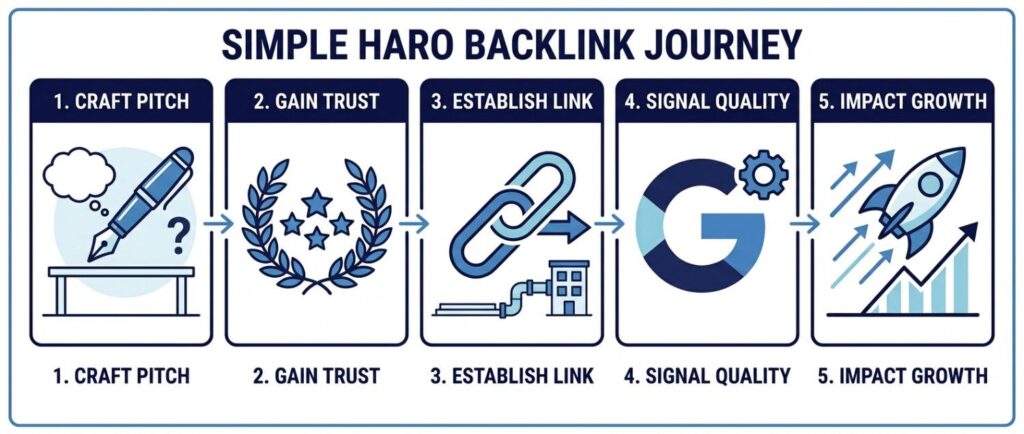
Despite all the changes, the strategy remains worth pursuing if you approach it with the right system. Here is the process I use for my clients today:
Step 1: Sign Up on Multiple Platforms
Do not rely on just one source of queries. Sign up for Qwoted, Featured.com, and SourceBottle at minimum. This increases your daily query volume without increasing your workload significantly.
Step 2: Set Up Category-Specific Alerts
Only monitor categories that match your real expertise. Responding to off-niche queries wastes time and signals to journalists that you are a mass spammer rather than a genuine expert.
Step 3: Filter Queries by Publication Quality
Before writing any pitch, check the publication the journalist works for. Use Moz or Ahrefs to verify domain authority. If the DA is below 40, weigh carefully whether the time investment produces enough SEO value.
Step 4: Lead Every Pitch with Your Credentials
Start with your title, credentials, and why you are qualified to answer. Then give your actual answer. Keep the entire pitch under 250 words. Journalists do not read long pitches.
Step 5: Respond Within the First Two Hours
Journalists receive dozens to hundreds of pitches per query. Early submissions get read first. Pitches arriving after the first few hours are often skipped entirely, regardless of quality.
Step 6: Track Every Submission
Keep a simple spreadsheet logging the platform, query category, pitch angle, and result. After 30 to 60 days, you will see patterns that tell you exactly where to focus your energy.
Step 7: Follow Up Once and Only Once
If a journalist has not published within two to three weeks, a single brief follow-up is acceptable. Never follow up more than once. Journalists remember sources who pester them and will stop reading your pitches.
What a Losing Pitch and a Winning Pitch Actually Look Like?
Theory is useful. Real examples are more useful. Here are two actual pitches from my campaigns, one that was rejected and one that earned a placement on HubSpot (DA 90+).
| LOSING PITCH | Niche: Travel | Result: Rejected, Not Published |
| One of the big reasons personalized travel is growing quicker than traditional tourism is that travelers now seem to place emotional connection above the usual checklist-style sightseeing. A lot of people dont want to feel like they are just moving through a standardized route made for mass appeal. Instead, they want experiences that feel personal, flexible, and culturally rooted, like they belong there for a bit. Travelers are also getting more deliberate about how they use both time and money. This shift has fueled growth in slow travel, wellness retreats, neighborhood-based stays, culinary experiences, and longer trips. Social media has sped this shift up, because travelers are constantly getting exposed to super individualized moments. Instead of running into generic tourism campaigns, people now find hidden diners, local practices, boutique lodgings through creators and peer suggestions. it shifts what they expect even before the trip starts. AI plus newer travel platforms are also reshaping how people plan. Recommendation engines, flexible itineraries, and personalized discovery tools make it easier to form a trip around personal interests, wellness targets, food preferences, or day to day lifestyle habits. rather than depending on prepackaged tours. The outcome is that traveling begins to feel assembled with care, more curated than transactional. Another big factor is flexibility, you see. Travelers today often mash together leisure remote work wellness and cultural exploration into one trip, and it feels very normal now. |
| Why This Pitch Was Rejected: – 320+ words. Journalists stop reading after 60 to 80 words if there is no clear hook or credential – Zero specific data, statistics, or original insight. Everything in this pitch is a generic observation – Lowercase ‘i’ and incomplete sentence fragments signal a careless, rushed submission – Reads like a generic blog post. There is no extractable expert quote anywhere in it |
| WINNING PITCH | Niche: B2B Technology | Result: Published on HubSpot (DA 90+) |
| Integration is the main thing I focus on. An AI meeting assistant should seamlessly integrate with all the tools your team already depends on, that is Google Workspace, Zoom, Slack, and CRM platforms, so that data flows automatically between systems. The moment the assistant started synchronizing notes and follow-ups right into client records, our admin time went down, and we stopped communicating twice. This easy-to-use system facilitated early ROI because the team could then work out meeting outcomes right away, which meant no re-entering of information or going into a different app. If there is no integration, then even a powerful assistant will constitute another silo; in any B2B adoption, therefore, compatibility is the real notion of value. |
| Why This Pitch Won: – Direct answer in 6 words: ‘Integration is the main thing’ – Specific tools named: Google Workspace, Zoom, Slack, CRM. These are verifiable, credible details – Personal firsthand experience stated clearly: ‘our admin time went down’ – Specific business outcome that a journalist can quote: ‘no re-entering of information’ – Under 150 words. A journalist could read the entire thing in under 30 seconds |
Losing vs Winning Pitch Side by Side
| Factor | Losing Pitch | Winning Pitch |
| Word count | 320+ words | Under 150 words |
| Credentials stated | None | Implied through specific tool expertise and firsthand results |
| Personal experience | None | Yes: admin time reduction mentioned explicitly |
| Specific tools or data | None | Google Workspace, Zoom, Slack, CRM all named |
| First sentence clarity | Generic observation about travel trends | Direct answer: ‘Integration is the main thing’ |
| Formatting quality | Lowercase errors, incomplete sentences | Clean, professional, extractable as a quote |
| Result | Not published | Published on HubSpot, DA 90+ |
The winning pitch was not better in a literary sense. It was better structured for a journalist’s specific needs. It answered the question immediately, backed it with real experience, and delivered that in under 150 words. That is the formula every pitch should follow.
Common Mistakes That Kill Your Response Rate
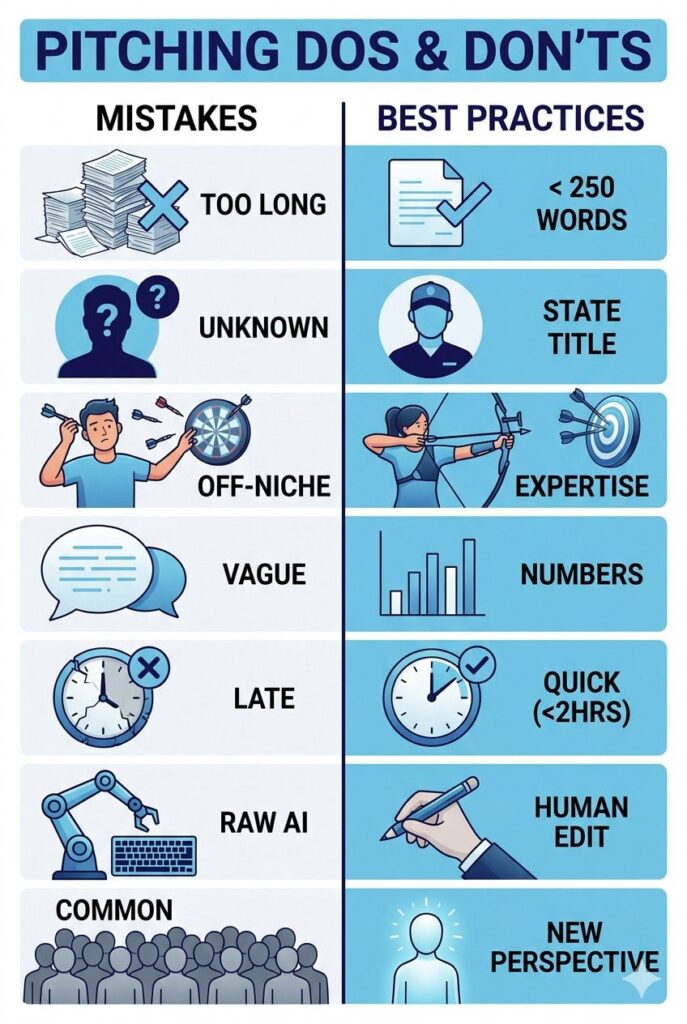
After reviewing thousands of pitches across dozens of client campaigns, these are the mistakes I see most consistently:
Common HARO Mistakes vs Best Practices
| Mistake | Why It Fails | What to Do Instead |
|---|---|---|
| Writing a 500-plus word pitch | Journalists do not have time for essays | Keep every pitch under 250 words |
| Not stating credentials at the start | Journalist moves to the next pitch immediately | Lead with your exact title and qualifications |
| Pitching off-niche queries | You come across as a mass-response spammer | Only pitch in your verified area of expertise |
| Generic answers with no real data | No differentiation from dozens of other pitches | Include specific numbers, results, and case references |
| Sending pitches hours after the query drops | Arrives too late to be seriously considered | Respond within two hours of receiving the digest |
| Using raw AI output without editing | Many journalists can recognize unedited AI text | Personalize and humanize every single pitch |
| Using the same angle as every other source | You disappear into the noise | Find a contrarian, unexpected, or hyper-specific perspective |
FAQ
Is HARO link building still worth it in 2026?
Yes, but only if you have genuine expertise or certified credentials. The strategy works best for licensed professionals, verified business owners, and recognized niche experts. If you are a general blogger without specific credentials, results will be inconsistent and require very high pitch volume to produce real placements.
Is HARO still active in 2026?
No. HARO shut down permanently in April 2024. The best active replacements are Qwoted, Featured.com, and SourceBottle. All three have free plans and deliver regular journalist queries from real publications.
How long does it take to get a HARO-style backlink?
Based on my campaigns, a successful outreach effort typically produces the first placement within four to eight weeks. Some queries lead to published articles within days. Others can take several months, depending on the journalist’s publishing schedule and editorial queue.
What niches work best with HARO-style link building?
Finance, health, legal, tech, and business consistently produce the most opportunities. These niches have the highest density of active journalist queries and the largest number of publications sourcing expert opinions. Real estate and SaaS are also strong-performing niches based on results from my client campaigns.
How many pitches should I send per week?
For solo operators, 20 to 30 pitches per week across all platforms is a solid starting target. For agencies managing multiple client profiles, 100 or more pitches per week is realistic. Always prioritize quality over raw volume. Sending 30 strong, credentialed pitches will outperform sending 200 generic ones.
Do journalists care more about the pitch or the person writing it?
Both matter, but credentials come first in 2026. If a journalist can choose between a certified expert with an average answer and an uncertified person with an excellent answer, they will choose the certified expert most of the time. This is because credentialed sources help publications meet Google’s E-E-A-T requirements and rank better in search results.
Conclusion
HARO link building remains one of the most effective ways to earn editorial backlinks from major publications. But the landscape has shifted significantly since I started running these campaigns in 2020.
Here are the key takeaways from this guide:
- Query volume has dropped from around 200 per edition to 20 to 30 on most active platforms
- AI tools have dramatically increased pitch competition, lowering average response rates across the board
- Journalist credentialing bias is now the biggest factor in getting selected
- Certified experts, including MDs, CPAs, attorneys, and PhDs, consistently outperform general content creators in response rates.
- If you are not a credentialed expert, adjust your expectations and compensate with tight niche targeting and higher pitch volume.
HARO-style link building still offers some of the highest-quality backlinks available anywhere in SEO. The path to earning them has just gotten narrower, more competitive, and more dependent on who you are rather than only what you write.
Ready to start? Sign up for Qwoted and Featured.com today, build out your expert profile with your real credentials and professional title, and begin responding to queries within your actual area of expertise.
About the Author
Muhammad Ahmad Khan is a HARO and Digital PR expert with over five years of active experience in journalist outreach and editorial link building. Since 2020, he has written thousands of pitches and secured hundreds of placements in publications including Forbes, Entrepreneur, Yahoo Finance, and USA Today. He specializes in building authority backlink campaigns for clients in SaaS, finance, real estate, health, legal, and business industries. Connect on LinkedIn.
