
Who this guide is for: This guide is for freelancers, agencies, and business owners who want to earn editorial backlinks through HARO-style pitching but do not yet know how to write a pitch that gets a reply.
It took me three to five months to earn my first HARO backlink. I had no roadmap, no mentor, and in 2020 there were barely any real guides on how to do this properly. This guide is the one I wish someone had handed me back then.
You will learn what HARO link building actually is, how the pitching process works today in 2026, and the exact mistakes that keep most beginners stuck at zero replies for months.
Here is the part most guides will not tell you: HARO in 2026 is not the HARO of 2020. AI has changed who applies, how journalists filter pitches, and how many journalists are even still using these platforms. If you skip that part, you will build your entire strategy around a platform that already moved on without you.
Quick Answer: HARO link building means responding to journalist queries with expert insight to earn a mention and backlink in a published article. In 2026, this works through platforms like Connectively, Qwoted, and Featured. Success depends on fast replies, relevant expertise, and pitches backed by real data, not on volume of queries sent.
What Is HARO Link Building?
HARO link building is the process of responding to journalist queries with expert quotes or data in exchange for a published mention and a backlink. Journalists post what they need, sources like you respond with a pitch, and if selected, your quote and link appear in the final article.
The original HARO platform went through several changes, acquired by Cision, rebranded as Connectively, shut down in 2024, then relaunched in 2026. For the full history and how the strategy itself survived that transition, see what HARO link building actually is.
This matters because these links come from real editorial content on sites journalists already trust, not from paid placements or link farms. A single link from a site like Forbes or Healthline carries more ranking weight than a dozen low-quality guest posts, because Google treats editorial mentions as a trust signal rather than a purchased signal.
How Does HARO Link Building Work?
- Sign up for a query platform such as Connectively, Qwoted, or Featured.
- Set your topic categories so you only receive queries in your niche.
- Read incoming queries as soon as they land in your inbox.
- Check the deadline and confirm you can realistically respond before it closes.
- Write a short pitch that answers the journalist’s exact question with a stat, a quote, or specific experience.
- Send the pitch within two hours of the query going live whenever possible.
- Track which pitches you sent and follow up only if the journalist explicitly allows it.
- Confirm the link once the article publishes and record the outlet, date, and URL.
HARO Link Building vs. Guest Posting: Key Differences
| Factor | HARO Link Building | Guest Posting |
|---|---|---|
| Cost | Free (time investment only) | Often $50 to $500+ per placement |
| Control over content | Low, journalist writes the article | High, you write the post |
| Turnaround time | Days to weeks, unpredictable | Usually faster, negotiated upfront |
| Link authority | Often DR 70+ on editorial sites | Varies widely, DR 20 to DR 80 |
| Scalability | Harder to scale, depends on query volume | Easier to scale with budget |
| Anchor text control | None, journalist decides | Usually negotiable |
HARO link building wins on authority and cost. Guest posting wins on predictability and control. Most agencies, including mine, run both in parallel rather than picking one.
HARO Link Building vs. Digital PR Agencies: Which Fits Your Budget?
| Factor | DIY HARO Link Building | Hiring a Digital PR Agency |
|---|---|---|
| Monthly cost | $0 to $50 (tool subscriptions) | $500 to $5,000+ |
| Time required | 5 to 10 hours per week | Near zero, fully outsourced |
| Learning curve | 3 to 5 months to first result | Immediate access to existing relationships |
| Link volume | 1 to 3 links per month once established | Varies by retainer, often higher |
| Best for | Solo bloggers, small budgets, hands-on founders | Businesses that need consistent monthly output |
Why HARO Link Building Still Matters in 2026
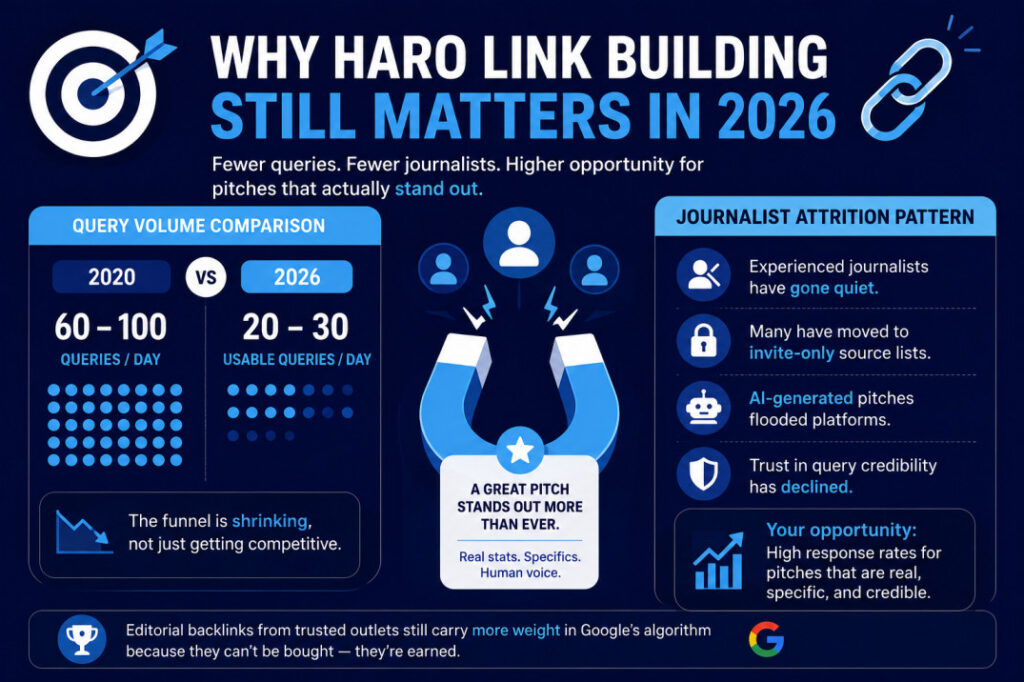
A backlink from a trusted editorial outlet still carries more weight in Google’s ranking systems than most other link types, because it cannot be bought outright and it comes with implied editorial trust.
That is the core reason this strategy has not died even as the platform itself went through major changes.
But 2026 looks nothing like 2020. Query volume on most platforms has dropped from what used to be 60 to 100 opportunities a day down to roughly 20 to 30 usable queries in many niches.
I have also noticed a real pattern over the last two years: several experienced journalists who used to run these queries constantly have simply gone quiet or moved to invite-only source lists.
I cannot say for certain why, but my working theory is that AI-generated pitches flooded these platforms so heavily that some journalists lost trust in query credibility and started sourcing experts privately instead.
That shift worries me more than any algorithm update, because it means the funnel itself is shrinking, not just getting more competitive.
The upside is that this exact shift is your opportunity. When 100 people are chasing 30 queries with AI-written pitches that all sound the same, a pitch with a real stat, a specific number, and a human voice stands out harder than it did in 2020, when volume made it easy to hide in the crowd.
That is the counterintuitive part beginners miss: fewer queries with more competition can still mean a better response rate for the pitch that actually stands out, precisely because most of what a journalist now receives reads like it came from the same template.
For a deeper breakdown of exactly how query volume and journalist behavior shifted year over year, the complete HARO link building guide covers this in more detail, including why credentials now outweigh pitch quality alone
How to Do HARO Link Building: Step by Step
Speed and relevance decide almost everything in HARO link building. Here is the exact sequence I use across client campaigns today.
- Build a one-page expert bio before you pitch anything. Journalists check credibility fast. Have your name, title, years of experience, and one credential ready to paste in.
- Filter for your real niche only. If your client is in health, finance, real estate, legal, SaaS, or crypto, only respond inside that lane. Pitching a shoe brand into a finance query, or the reverse, wastes your time and damages your sender reputation over time.
- Read the full query before drafting anything. Journalists often bury the real requirement in the second or third sentence, not the headline.
- Reply within the first two hours of the query going live. After that window, most slots are already filled internally by the journalist, even if the deadline is technically still open.
- Lead your pitch with a stat or a specific number, not a greeting. “We saw a 34% increase in X across Y clients” earns more attention than “Hi, I’d love to contribute to this piece.”
- Keep the pitch under 150 words. Journalists scan dozens of these in one sitting. Long pitches get skipped, not read twice.
- Attach one line of bio and one contact detail at the end, not the top. The insight needs to lead, credibility supports it after.
- Log every pitch you send with the outlet, date, and query topic. This is the only way to know your real response rate instead of guessing.
- Never follow up unless the platform explicitly permits it. An unsolicited follow-up on most platforms reads as spam and can get you flagged.
- Track published links weekly, not daily. Most placements take two to six weeks to go live after acceptance, so daily checking just creates false disappointment.
Real Examples From Client Campaigns
Example 1: My own first pitch. When I started in 2020, I genuinely thought “responding to a query” meant sharing our client’s existing blog content with the journalist, like a content swap. I sent a full blog post link instead of an actual quote answering their question. Looking back now, it is funny how far off that was from what pitching actually means, but at the time nobody had explained the difference between contributing an answer and promoting a page.
Example 2: Finance client, health insurance query. A client in personal finance responded to a query about health insurance costs with a specific stat pulled from their own client data rather than a generic industry claim. The specificity of the number is what got picked up, not the length of the pitch.
Example 3: Real estate client, market trend query. A real estate client answered a query about regional housing trends with a two-sentence direct answer plus one supporting number, sent within the first hour of the query posting. Speed combined with a direct answer format, rather than a long explanation, is what got the response used.
Niches That Work Best for HARO Link Building
| Niche | Query Volume | Why It Works |
|---|---|---|
| Health | High | Journalists constantly need medical and wellness sources |
| Finance | High | Personal finance and investing queries run year-round |
| Real Estate | Moderate to High | Market trend stories need local and national data sources |
| Legal | Moderate | Consumer-facing legal questions are a steady category |
| SaaS | Moderate | Tech and productivity coverage has grown since 2023 |
| Crypto | Moderate | Volatile but consistent given ongoing market coverage |
| Fashion or Shoes | Low | Rarely covered in query-based journalism, weak fit for this method |
If your client sits outside the first six categories, HARO link building may not be the right primary strategy, and that is worth telling them upfront rather than promising results you cannot control.
Common Mistakes to Avoid
- Pitching outside your real niche. Sending a shoe or fashion pitch into a finance or health query wastes the journalist’s time and yours. Stick to categories where your expertise is genuine.
- Writing pitches longer than 150 words. Journalists are scanning fast. A pitch that takes 30 seconds to read beats one that takes three minutes, every time.
- Replying after the two hour window. I learned this the hard way early on, sending strong pitches a full day after a query posted and getting zero replies, even when the content was good.
- Treating query response as content promotion. My own first pitch mistake. The journalist wants your insight, not your blog link.
- Expecting fast results. It took three to five months of consistent pitching before I earned my first real placement. Anyone promising links in the first two weeks is setting the wrong expectation.
- Following up without permission. Some platforms explicitly discourage this. A follow-up where it is not allowed reads as spam, not persistence.
Best Tools for HARO Link Building
| Tool | Best For | Price | Pros | Cons |
|---|---|---|---|---|
| Connectively | General query volume across niches | Free tier, paid plans available | Largest query pool, direct successor to HARO | Volume has dropped compared to 2020 to 2022 |
| Qwoted | PR-focused pitching with journalist profiles | Free tier, paid plans available | You can see journalist history before pitching | Smaller query volume in some niches |
| Featured | Question and answer style expert responses | Free tier, paid plans available | Good for building a public expert profile over time | Less newsroom-direct than Connectively |
| Make.com | Automating pitch triage and client routing | Paid, usage-based | Cuts manual sorting time across many clients | Requires setup time upfront |
I personally run Connectively and Featured side by side for most clients, with Make.com automating the initial query sorting so I am not manually scanning every single email across 20 accounts.
Pitch Response Rate by Pitch Length
| Pitch Length | Typical Response Rate | Why |
|---|---|---|
| Under 100 words | Highest | Fastest to scan, easiest to lift a quote from |
| 100 to 150 words | Strong | Still scannable, room for one stat plus context |
| 150 to 250 words | Weaker | Journalists start skimming, key point gets buried |
| 250+ words | Weakest | Rarely read in full during high-volume scanning |
This is a pattern I have seen consistently across client accounts. Shorter is not just a style preference; it directly changes whether the journalist reads the pitch at all.
Frequently Asked Questions
How long does HARO link building take to get results?
Most beginners should expect three to five months before earning a first real placement. This was true in my own experience starting in 2020, and it remains realistic in 2026 given lower query volume across most platforms.
Is HARO link building still worth it in 2026?
Yes, but expectations need to adjust. Query volume has dropped to roughly 20 to 30 usable queries per niche in many categories, so consistency and pitch quality matter more than the raw number of queries you respond to.
Why do fewer journalists seem to use HARO-style platforms now?
Several experienced journalists appear to have reduced their use of open query platforms since 2024, likely linked to AI-generated pitches flooding these systems and reducing trust in query credibility. Some have shifted toward private, invite-only source lists instead.
What should freelancers and agencies look for in a client niche?
Health, finance, real estate, legal, SaaS, and crypto niches tend to have the most consistent query volume. Niches like general fashion or shoes see far fewer relevant queries, making links harder to earn regardless of pitch quality.
Do statistics really help a HARO pitch get picked?
Yes, journalists consistently favor pitches with a specific number or data point over general claims, since it gives them something concrete to cite in the published article.
Final Thoughts
Do not judge your first month by whether you got a link. Judge it by whether you sent fast, relevant, well-targeted pitches consistently. The link follows the habit, not the other way around.
Here is your action for today: pick one query platform, set your niche filters to only the categories that actually match your expertise, and commit to checking it within a two hour window for the next 14 days straight. Track every pitch you send in a simple spreadsheet with the outlet name, date, and topic.
