
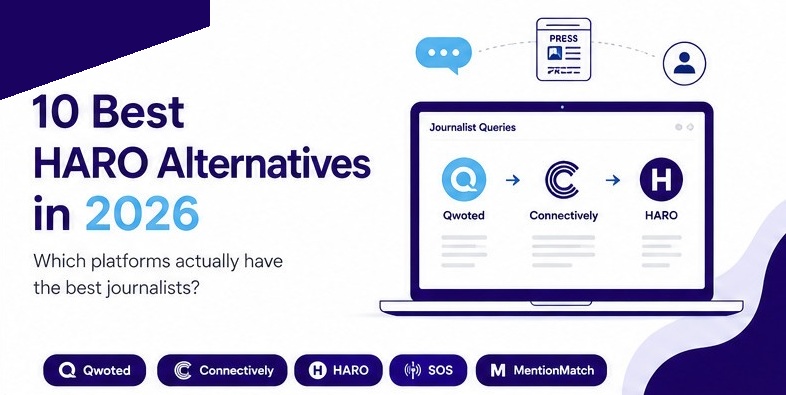
HARO relaunched under its own domain, but 2026 is the worst year the platform has ever had. If you’re completely new to HARO, start with our What Is HARO Backlinking? guide that explains how HARO works, why SEOs use it, and how it helps earn editorial backlinks, before comparing alternative platforms. The journalists who used to make it valuable have largely left. GoBankingRates, Homes & Gardens, Yahoo, Nasdaq, and Bloomberg barely show up on HARO anymore, and Forbes appears only occasionally now. Almost all of them moved to Qwoted instead.
This article ranks the 10 platforms actually worth using in 2026, based on five-plus years of running HARO campaigns across 20+ client accounts, not recycled vendor pricing pages.
This guide is for link builders, digital PR freelancers, business owners, and in-house SEOs who need to know which platform actually has the journalists in 2026, not just which one has the biggest marketing budget.
Here is what most “HARO alternatives” articles get wrong: they treat HARO’s comeback as a return to form. It isn’t. We have run pitches on HARO, Qwoted, Connectively, SOS, MentionMatch, ProfNet, and JournoFinder simultaneously across health, finance, tech, real estate, legal, and crypto clients, and the pattern is consistent. Journalist quality has collapsed on HARO specifically, even though the platform itself is back and functioning.
Quick Answer: Qwoted is the strongest platform for link building in 2026. It now hosts the top-tier journalists and outlets that used to publish on HARO, including GoBankingRates, Homes & Gardens, Yahoo, Nasdaq, and Bloomberg. The tradeoff is cost: Qwoted is paid, and it is the most expensive platform in this category. Connectively (formerly Terkel/Featured) ranks second, with more active journalists than HARO right now. HARO itself has real functionality but the weakest journalist pool it has had in years.
Why 2026 Is HARO’s Worst Year?
HARO is live again on its own domain. That part is true. What most guides miss is what happened to the journalist pool while HARO was away from the market: it did not come back with them.
GoBankingRates used to be a reliable HARO source for finance link builders. In 2026, it is gone from HARO and shows up on Qwoted instead. Homes & Gardens followed the same path.
Yahoo, one of the biggest names link builders chased on the original HARO, no longer appears there at all and is now a Qwoted-only placement.
Nasdaq and Bloomberg, both top-tier finance and news outlets, are also absent from HARO in 2026. Forbes still appears on HARO occasionally, but nowhere near the frequency it used to.
The reason is simple: journalists went to Qwoted during the window when HARO did not exist, and most of them never came back. A platform is only as good as the journalists posting queries on it, and right now that pool has shifted almost entirely to Qwoted.
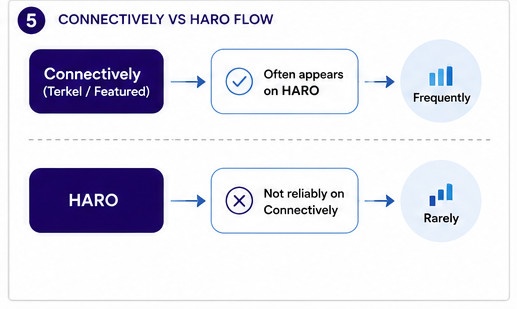
There is one detail worth knowing if you are running both platforms: queries that appear on Connectively (the platform now operating under the Terkel/Featured lineage) also tend to show up on HARO. The reverse is not true.
Queries that were originally posted on Connectively do not reliably appear on HARO. That asymmetry matters if you are deciding which platform to check first each morning.
How Do You Choose a HARO Alternative?
The right platform depends on your client’s niche far more than it depends on which platform has the best reputation. Qwoted is the strongest all-around platform in 2026, but it is also the most expensive, and paying for it on a niche where a free platform performs just as well is wasted budget.
Health clients do well across nearly every platform: HARO, SOS, Qwoted, and Connectively all produce results. Mental health specifically is a different story.
It performs best on Qwoted and worst on ProfNet, where mental-health-related queries are rare. Tech clients see the strongest results on HelpAB2B, now rebranded as MentionMatch. Crypto clients also perform best on MentionMatch. Home and general-interest queries lean toward Qwoted.
Travel is the one category where platform choice barely matters, since query volume and quality stay roughly even across all of them. Finance clients do well on HARO, SOS, and Qwoted alike.
HARO Alternatives Compared at a Glance:
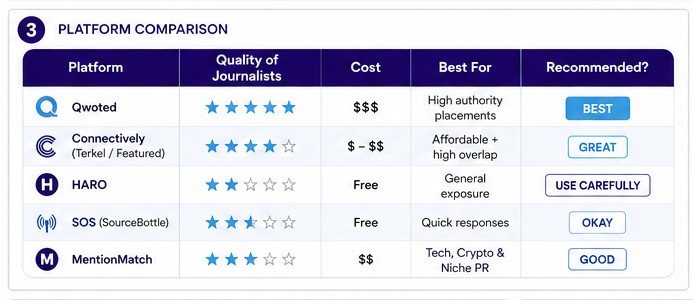
The best HARO alternative depends on the client’s niche, not on which platform has the biggest name. Health, finance, and general queries perform well on HARO, SOS, Qwoted, and Connectively together. Mental health performs best on Qwoted and worst on ProfNet. Tech and crypto perform best on MentionMatch, formerly HelpAB2B. Home and general-interest queries lean toward Qwoted. Travel is the one niche where platform choice barely matters, since results stay roughly even across every platform.
| Platform | Cost | Journalist Quality in 2026 | Best For |
|---|---|---|---|
| Qwoted | Paid, most expensive in category | Highest, absorbed most top-tier journalists from HARO | Finance, mental health, general/home niches |
| Connectively (Terkel/Featured) | Free to paid tiers | Strong, more active journalists than current HARO | General queries, overlaps with HARO |
| HARO | Free | Weakest it has been in years | Finance, health (as part of a multi-platform stack) |
| SOS (Source of Sources) | Free | Same function as HARO, lower query volume | Health, finance |
| MentionMatch (formerly HelpAB2B) | Paid | Journalists present but mostly DR 50 and under | Tech, crypto |
| ProfNet | Paid, expensive | Few journalists, weakest of the paid platforms | Not recommended as a primary platform |
| JournoFinder | Paid | Good journalist quality | Supplementary journalist search |
Assessment based on direct freelance campaign experience across 20+ client accounts in 2026, not vendor marketing claims.
The 10 Best HARO Alternatives in 2026
1. Qwoted
Qwoted is the best platform for link building in 2026, and it is not close. The journalists and outlets that used to define HARO’s value, GoBankingRates, Homes & Gardens, Yahoo, Nasdaq, and Bloomberg, have moved here.
The tradeoff is cost. Qwoted is a paid platform, and it is the most expensive one in this category. For niches where placement quality matters more than budget, especially finance, mental health, and general or home-related queries, the cost is worth it.
2. Connectively (Terkel / Featured)
Connectively, HARO, and Featured trace back to the same lineage, and in 2026 Connectively is running with more active journalists than HARO itself.
A useful pattern we have tracked directly: queries posted on Connectively frequently also appear on HARO later, but queries that originate on HARO do not reliably show up on Connectively. If you only have time to check one platform first each day, Connectively is the better catch-all.
3. HARO
HARO is back on its own domain and functional, but 2026 is its weakest year in terms of journalist quality. The high-authority names that made HARO worth the daily grind, GoBankingRates, Homes & Gardens, Yahoo, Nasdaq, Bloomberg, are largely gone.
Forbes still appears, but only occasionally. HARO still earns a place in a client’s platform stack for finance and health niches, but it should not be your only platform in 2026.
4. SOS (Source of Sources)
SOS runs the same basic function as HARO: free inbound journalist queries. The difference is volume. SOS produces fewer queries than HARO, which is already running below its historical average.
It still has a place for health and finance clients as a supplementary free source, but it should not be your primary platform.
5. MentionMatch (formerly HelpAB2B)
HelpAB2B rebranded to MentionMatch. The journalists are there, and it is the strongest platform for tech and crypto niches specifically, but the trade-off is link quality.
Most of the outlets on MentionMatch sit around DR 50 or lower. You will get consistent numbers of links from this platform, just not the DR 70+ placements Qwoted can produce.
6. ProfNet
ProfNet is not worth heavily promoting in 2026. It has very few active journalists compared to the other platforms on this list, and it is priced at the expensive end despite that thin journalist pool.
It performs especially poorly for mental health queries specifically, where relevant requests are rare. Treat it as a last resort rather than a core platform.
7. JournoFinder
JournoFinder is a paid journalist search tool with genuinely good journalist quality. It is not an inbound query feed like HARO or Qwoted; it is better used to supplement one, letting you find and directly target journalists who cover a specific beat rather than waiting for them to post a matching request.
8. SourceBottle
SourceBottle remains a free, working option, strongest for lifestyle, parenting, travel, and general regional coverage, particularly in Australia, New Zealand, and the UK. It fills a gap that the other platforms on this list, which skew toward US finance and tech, do not cover well.
9. Cision (Enterprise Tier)
Cision’s enterprise database and distribution wire, separate from the Connectively product it previously owned, remains available for large in-house PR teams with existing Cision contracts. It is not built or priced for solo freelancers.
10. Prezly
Prezly is a PR CRM rather than a query platform. It lets you import existing media contacts and manage direct outbound pitching instead of waiting on inbound requests. Use it alongside a query platform, not as a replacement for one.
Which Platform Wins by Niche?
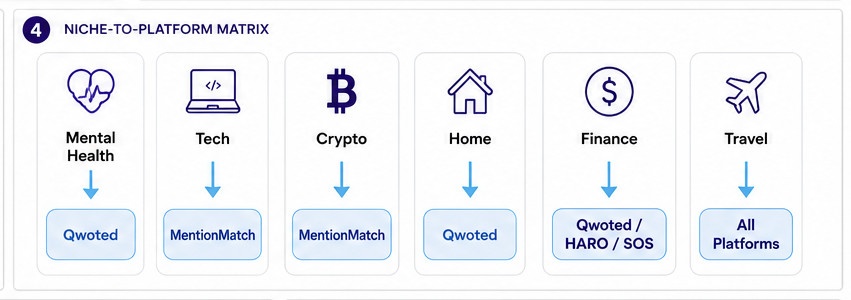
The best HARO alternative depends on the client’s niche, not on which platform has the biggest name. Health, finance, and general queries perform well on HARO, SOS, Qwoted, and Connectively together. Mental health performs best on Qwoted and worst on ProfNet. Tech and crypto perform best on MentionMatch, formerly HelpAB2B. Home and general-interest queries lean toward Qwoted. Travel is the one niche where platform choice barely matters, since results stay roughly even across every platform.
Health (general): General health queries are one of the few categories where nearly every platform delivers. HARO, SOS, Qwoted, and Connectively all produce usable journalist requests for health clients, which is why we run all four simultaneously for this niche rather than picking just one. There is no single platform that clearly outperforms the others here, so the smarter move is coverage across all four rather than narrowing down.
Mental health: Mental health is a narrower category than general health, and it splits sharply by platform. Qwoted is the strongest fit, consistently surfacing relevant mental health queries from quality outlets. ProfNet sits at the opposite end: mental-health-related requests are rare there, making it the weakest platform for this specific niche despite being a paid tool.
Tech: Tech clients see their strongest results on MentionMatch, the platform formerly known as HelpAB2B. The journalist pool there is active and produces a steady volume of links. The tradeoff is authority: most outlets on MentionMatch sit around DR 50 or lower, so expect consistent placements rather than top-tier DR wins.
Crypto: Crypto follows the same pattern as tech. MentionMatch is the strongest platform for this niche, delivering reliable link volume from a journalist pool that regularly covers crypto topics, again with outlet authority mostly in the DR 50 and under range.
Home / general queries: For home improvement, general lifestyle, and broad consumer queries, Qwoted consistently produces the strongest results. This lines up with the platform’s broader 2026 strength: it has absorbed much of the journalist pool that used to make HARO valuable for general-interest niches.
Travel: Travel is the exception to the rule that platform choice matters. Query volume and quality stay roughly even across HARO, Qwoted, Connectively, and SOS for travel clients, so platform selection here comes down to budget and workflow convenience rather than which platform has better journalists.
Finance: Finance clients perform well across HARO, SOS, and Qwoted. Unlike mental health or tech, no single platform dominates this niche. The safest approach is running all three, since each one surfaces different finance journalists and outlets worth pitching.
| Niche | Best Platform(s) | Notes |
|---|---|---|
| Health (general) | HARO, SOS, Qwoted, Connectively | Performs well across nearly every platform |
| Mental health | Qwoted | Best fit; ProfNet performs worst here |
| Tech | MentionMatch (HelpAB2B) | Strongest volume of links, mostly DR 50 and under |
| Crypto | MentionMatch (HelpAB2B) | Same strength as tech |
| Home / general queries | Qwoted | Consistently strong results |
| Travel | All platforms roughly equal | Platform choice matters least here |
| Finance | HARO, SOS, Qwoted | All three perform well |
How to Switch From HARO to a New Platform:
- Identify your client’s niche before picking a platform. Use the niche table above rather than defaulting to whichever platform is most talked about.
- Run more than one platform for niches that support it. Health and finance clients benefit from being on HARO, SOS, and Qwoted simultaneously rather than choosing just one. Once you’ve selected the right platform, the next step is writing pitches that actually earn links. Our complete HARO Link Building Guide walks through the entire outreach process—from finding opportunities to crafting winning responses.
- Budget for Qwoted where it matters most. For mental health, general, and home niches, Qwoted’s cost is worth paying. For niches that perform well on free platforms, skip it.
- Check Connectively before HARO each morning. Queries on Connectively often surface on HARO later, but not the other way around, so checking Connectively first catches more opportunities.
- Treat MentionMatch as a volume play, not a DR play. Expect steady numbers of links for tech and crypto clients, but set client expectations around DR 50 and under rather than top-tier authority.
- Avoid ProfNet as a primary platform. Its thin journalist pool and high cost make it a poor fit unless a client specifically needs it.
- Add JournoFinder for direct targeting, not inbound waiting. Use it to find and pitch specific journalists rather than treating it like a query feed.
- Reassess platform mix every 60 days. Journalist migration between platforms has already reshaped this market twice; it will likely shift again.
Real Results: How We Split 20 Clients Across Platforms
Across our 20-plus client roster, we do not run every client on the same platform.
We match the platform stack to the client’s niche every time. For health clients specifically, since HARO, SOS, Qwoted, and Connectively all perform well for that niche, we run all four simultaneously rather than picking just one and hoping it delivers.
For tech and crypto clients, MentionMatch gets the primary allocation of pitching time since it is the strongest performer there, even though the resulting links sit around DR 50.
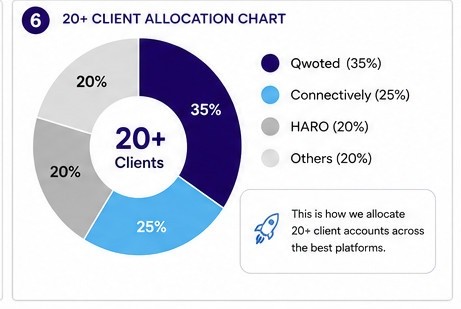
For mental health clients, Qwoted gets the bulk of the pitch volume, since it is both the strongest platform for that specific niche and the one where ProfNet, by contrast, barely produces relevant queries at all.
The mistake we no longer make: assuming HARO’s brand recognition means it still has the journalist quality it used to.
In 2026, that assumption costs placements. GoBankingRates, Yahoo, Nasdaq, and Bloomberg are outlets we now pitch almost exclusively through Qwoted, not HARO, because that is simply where those journalists post their queries now.
Common Mistakes to Avoid:
- Assuming HARO’s relaunch restored its old journalist quality. It didn’t. Top outlets moved to Qwoted and mostly stayed there.
- Skipping Qwoted because of the cost. For finance, mental health, and general niches, the paid cost is offset by meaningfully better placements.
- Over-promoting ProfNet. Its thin journalist pool and high price make it a weak primary choice in 2026.
- Expecting DR 70+ links from MentionMatch. It is a strong volume platform for tech and crypto, not a high-authority one.
- Checking HARO before Connectively. Since Connectively queries often appear on HARO later but not the reverse, checking HARO first means missing opportunities that were already visible on Connectively.
Best Tools for Managing Multi-Platform Pitching
| Tool | Best For | Notes |
|---|---|---|
| Qwoted | Highest-quality placements | Paid, most expensive, but hosts the top journalist pool in 2026 |
| Connectively | Daily catch-all query feed | Free to paid tiers, more active journalists than HARO right now |
| MentionMatch | Tech and crypto link volume | Paid, DR 50 and under links |
| JournoFinder | Direct journalist targeting | Paid, supplements inbound query platforms |
| Make.com | Automating pitch routing across platforms | Connects Gmail and Notion for multi-client, multi-platform pitch triage |
We run our own pitch triage through a Make.com automation pipeline connected to Gmail and Notion, which routes incoming queries by client and by platform before a pitch gets drafted.
Manually tracking seven platforms across 20 clients without this kind of pipeline does not scale.
Frequently Asked Questions
Is HARO back in 2026?
Yes, HARO relaunched on its own domain. Functionally, the platform works, but the journalist pool that made it valuable has largely moved to Qwoted, making 2026 its weakest year for link building despite being technically active again.
Which platform has the best journalists in 2026?
Qwoted currently has the strongest journalist pool, including outlets that used to be reliable HARO sources: GoBankingRates, Homes & Gardens, Yahoo, Nasdaq, and Bloomberg. Forbes still appears occasionally but far less often than it used to.
Is Qwoted worth the cost?
For finance, mental health, and general or home-related niches, yes. Qwoted is the most expensive platform in this category, but the placement quality for those niches outweighs the cost. For niches like tech or crypto, a platform like MentionMatch may deliver better value.
What is the difference between HARO and Connectively?
Both trace back to the same underlying platform lineage. In 2026, Connectively has more active journalists than HARO. Queries posted on Connectively often also appear on HARO later, but the reverse is not reliable, so Connectively is worth checking first.
Is ProfNet a good HARO alternative?
Not as a primary platform. ProfNet has a small journalist pool relative to its cost, and it performs especially poorly for niches like mental health, where relevant queries are rare.
Which platform is best for tech and crypto link building?
MentionMatch, formerly HelpAB2B, is the strongest platform for both tech and crypto niches. Expect a steady volume of links, though most sit around DR 50 or under rather than top-tier authority.
Final Thoughts
Do not choose a platform based on brand recognition alone. HARO’s name still carries weight, but the journalists who made it valuable have mostly relocated to Qwoted, and no amount of nostalgia changes that in 2026.
If you’re still learning the fundamentals of HARO, read our complete What Is HARO Backlinking? guide before choosing an alternative platform.
Match your platform stack to your client’s niche this week using the niche table above, and revisit that stack every 60 days as journalist migration continues to reshape this market.
