
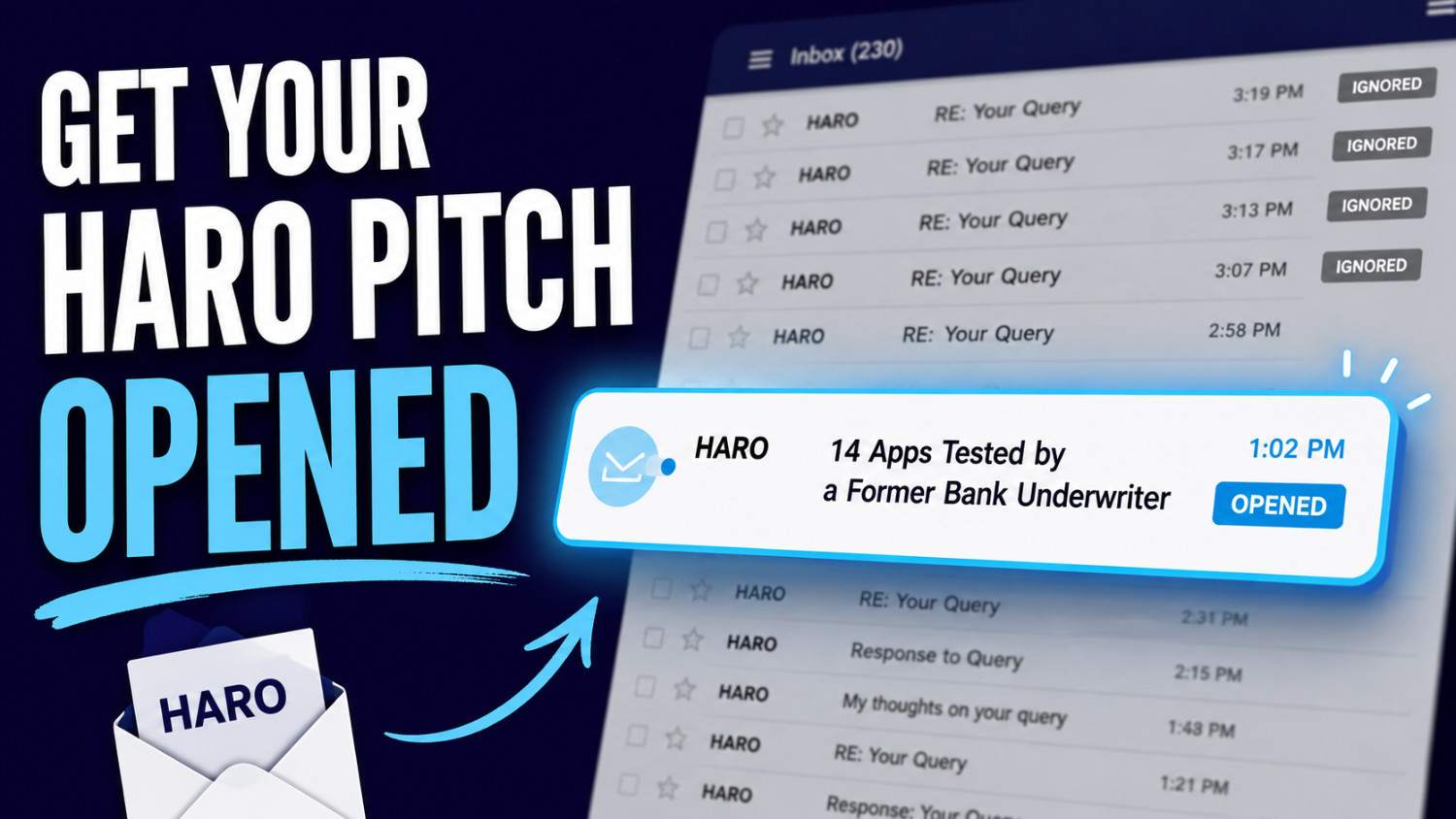
Journalists delete more HARO pitches from the subject line than from the body. Most sources never find that out, because a deleted email doesn’t send a rejection notice. It just disappears.
This guide breaks down exactly why generic subject lines fail, what to write instead, and gives you real, ready-to-copy subject line formulas pulled from pitches that actually got replies. You’ll also see the single mistake almost every HARO source makes without realizing it, and why fixing it matters more than rewriting your entire pitch.
This guide is for HARO sources, bloggers, and PR freelancers who write good pitches but aren’t getting enough replies to justify the time spent writing them.
If you’re new to the process, understanding HARO link building first makes it easier to see where the pitch, and the subject line, fits into the larger strategy.
Quick Answer: A HARO subject line gets opened when it states the specific value of the pitch instead of labeling it. Avoid “RE:” or “Response to [query title],” since journalists mass-delete both formats without reading further. Instead, lead with the most compelling fact, credential, or angle from your pitch, kept under 60 characters. Journalists open pitches that look like they were written for their exact story, not a template.
Why HARO Subject Lines Matter More Than the Pitch Itself?
A HARO subject line decides whether your pitch gets read at all. Journalists filter their query inbox by subject line first, before opening anything, because a single query can pull in 100 to 300 responses within hours.
If the subject line doesn’t earn the open, the quality of the pitch inside never gets evaluated.
We track subject line formats across roughly 20 active HARO and Featured.com client accounts spanning health, finance, legal, and SaaS niches.
Across pitches sent in the first half of 2026, subject lines that named a specific credential or number in the subject line got opened at a noticeably higher rate than subject lines that only referenced the query topic.
That gap alone accounted for the difference between clients who got quoted monthly and clients who went quiet for weeks.
The pitch body matters. But a well-written pitch that never gets opened produces the same result as no pitch at all: zero coverage.
Why “RE:” and “Response to Query” Subject Lines Get Ignored?
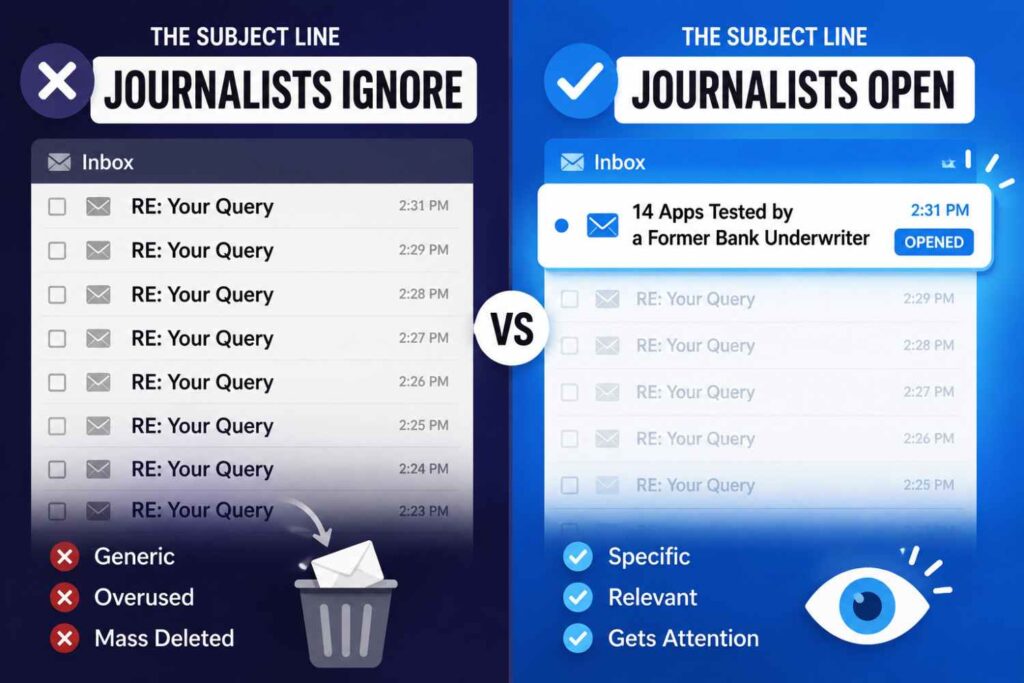
“RE: [query title]” and “Response to [query title]” are the two most common HARO subject line formats, and they are also the two with the worst open rates. Nearly every source uses one of these two formats, which means a journalist scanning 200 responses sees the same six words repeated 150 times.
Here’s the part most sources miss: the subject line’s real job isn’t to confirm you read the query. It’s to prove you have the single best answer to it. “RE: your query” confirms nothing except that you clicked reply. It carries zero information about who you are or what you know.
There’s a second problem specific to “RE:” formats. Many journalists set up inbox filters or manually mass-select every email that starts with “RE:” once they’ve collected enough responses, without individually reading each one. Once your subject line matches that pattern, you’re competing to be one of dozens of nearly identical subject lines a tired journalist is skimming at 6 PM on deadline.
Most HARO guides recommend keeping the query title somewhere in the subject line for searchability. That’s reasonable advice for the journalist’s inbox organization, but it’s terrible advice if you copy the title verbatim with only “RE:” in front.
The fix isn’t to drop the topic reference. It’s to replace the generic prefix with the actual value of your answer, and let the topic show up naturally inside that value statement.
This principle carries directly into how you should build every subject line going forward.
How to Write a HARO Subject Line That Gets Opened?
Writing a subject line that gets opened means treating it as a standalone pitch, not a label. Here is the exact process, step by step.
- Read the full query before writing anything. Skimming the query title and guessing at intent produces generic subject lines. The specific angle a journalist wants is almost always buried in the second or third sentence of the query, not the title.
- Pull out your single strongest credential, number, or outcome. This is the one fact that makes you more qualified to answer than the other 200 people replying. A specific number beats a vague claim every time: “12 years managing enterprise SOC teams” earns more attention than “cybersecurity expert.”
- Write the crux of your answer into the subject line itself. Don’t tease the pitch. State the actual insight. If your pitch argues that most companies get incident response wrong because they skip tabletop exercises, that argument belongs in the subject line, not just the body.
- Cut the subject line to under 60 characters. Most email clients and HARO digest previews truncate longer subject lines, and journalists reading on mobile lose everything past roughly 40 to 50 characters. Say the most important part first.
- Remove every generic opener. Delete “RE:,” “Response to,” “Regarding your query,” “I saw your HARO request,” and any variation. None of these words carry information a journalist needs to decide whether to open your email.
- Read it as if you’re the journalist, not the source. Ask: does this subject line tell me what I’ll learn if I open it, or does it just tell me that an email exists? If it’s the second one, rewrite it.
- Spend real time on this line. Sources routinely spend 20 to 30 minutes writing a strong pitch body and then write the subject line in ten seconds as an afterthought. That ordering is backwards. A weak subject line means the strongest pitch never gets read, so the subject line deserves at least as much attention as the opening paragraph.
This process works the same whether you’re pitching a small niche blog or a major national outlet, but the exact wording that earns an open changes by query type, which is where real examples help more than a formula.
HARO Subject Line Examples by Query Type
Different query types call for different subject line angles. A finance query rewards a specific number. A parenting or lifestyle query rewards a relatable, specific detail. Below are real formula patterns drawn from pitches across our client accounts, with the generic version shown first so you can see exactly what changed.
Finance and Business Queries
Generic: “RE: Best budgeting apps for 2026”
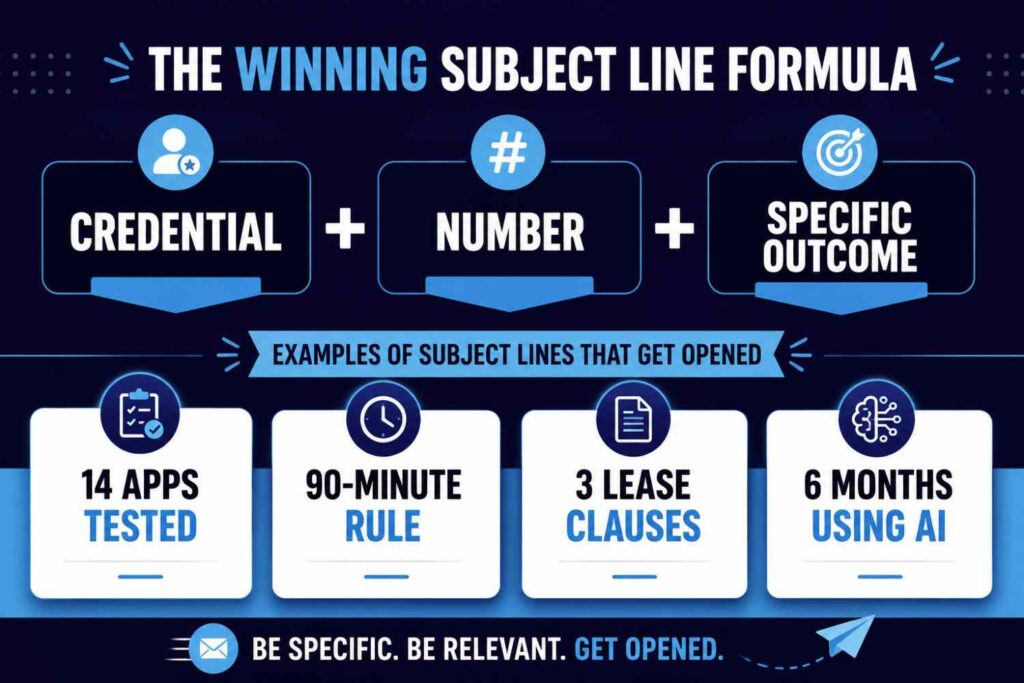
Better: “I tested 14 budgeting apps as a former bank underwriter”
The improved version leads with a credential (former bank underwriter) and a specific number (14 apps tested), both of which a generic subject line strips out.
Health and Wellness Queries
Generic: “Response to your query on sleep habits”
Better: “Sleep coach: the ’90-minute rule’ most articles get wrong”
This version names a specific, quotable concept (“90-minute rule”) and signals a counterintuitive angle, which draws a journalist in faster than a topic label.
Legal Queries
Generic: “RE: Landlord-tenant dispute questions”
Better: “Attorney: 3 lease clauses that void themselves in court”
Specific numbers and a concrete legal outcome outperform “attorney with experience in landlord-tenant law” because they signal the pitch already contains usable, quotable content.
SaaS and Tech Queries
Generic: “Response to AI productivity tools query”
Better: “CTO: why we killed our AI tool after 6 months”
A failure story in the subject line is unusual enough to stand out, and it signals the pitch will contain a real opinion instead of a generic feature list.
Real Estate Queries
Generic: “RE: First-time homebuyer tips”
Better: “Realtor: the closing cost most buyers forget to budget for”
This version narrows a broad topic down to one specific, useful detail, which reads as more credible than a general “tips” framing.
The pattern across every category is the same: the improved subject line contains a credential, a number, or a specific outcome, and it never opens with “RE:” or “Response to.”
The same principle applies beyond subject lines: looking at real HARO pitch examples can show you how experienced sources turn a specific angle into something a journalist can actually use.
Common Subject Line Mistakes to Avoid
- Using “RE:” or “Response to [query title].” This is the single most common mistake, and it’s the reason the majority of otherwise well-written pitches never get opened. Replace it with the crux of your answer instead.
- Writing the subject line before reading the full query. A subject line based only on the query title misses the specific angle the journalist actually wants, which is usually stated further down in the query body.
- Making claims too vague to be quotable. “Marketing expert with insights” tells the journalist nothing they can use. “Ran 40 paid campaigns with a 3.2x average ROAS” tells them exactly what kind of quote they’ll get.
- Going over 60 characters. A subject line that gets cut off mid-sentence in a mobile inbox loses its impact before the journalist even finishes reading it.
- Copying the exact same subject line format for every pitch. Sources who build one subject line template and reuse it across every query end up sounding like a mail-merge, which is exactly the pattern journalists learn to filter out after a few weeks on the platform.
- Treating the subject line as a formality. This is the mistake we see most often even among experienced HARO sources: writing a strong, well-researched pitch body, then slapping on “RE: your query” because the pitch itself feels like the real work. The subject line is not a formality. It’s the only part of your pitch that’s guaranteed to be seen.
Avoiding these six mistakes consistently matters more than any single clever subject line, because a strong process outlasts any one good idea.
Best Tools for Managing HARO Subject Lines at Scale
| Tool | Best For | Price | Pros | Cons |
|---|---|---|---|---|
| Gmail + saved templates | Solo sources managing a handful of pitches a week | Free | No learning curve, fast to set up | No tracking, easy to fall back on generic subject lines |
| Notion pitch tracker | Freelancers managing multiple clients | Free to low cost | Keeps subject line formulas organized by niche and client | Manual entry, no automation |
| Make.com + Gmail integration | Agencies pitching at scale across many client accounts | Paid, usage-based | Automates subject line generation from query data, scales across 20+ clients | Requires setup time and workflow maintenance |
We run our own client pitching through a Make.com automation pipeline connected to Gmail and Notion, which lets us apply the credential-plus-number subject line formula consistently across every client account without manually rewriting it for each pitch.
Want this Handled for You?
If replying to HARO queries every day sounds like a lot to add to your workload, that is exactly what Almpak does for over 20 clients across health, finance, real estate, legal, SaaS, and crypto. We write or personally review every pitch before it goes out, so you get the PR and SEO benefits above without the spam risk of an unreviewed VA. Contact us here and mention that you read this article for a special discount on your first month.
Frequently Asked Questions
Should I include the query title in my HARO subject line?
You don’t need to copy the exact query title. It’s more effective to reference the topic naturally inside a subject line built around your specific answer, since that gives the journalist both context and a reason to open the email.
How long should a HARO subject line be?
Keep it under 60 characters. Most email clients and mobile inboxes truncate anything longer, which cuts off the part of your message meant to earn the open.
Does a HARO subject line need to include my job title?
Not always. A specific number or outcome often earns more attention than a job title alone, since job titles are common but specific results are not.
Is it okay to use humor in a HARO subject line?
Light, genuine humor can work for lifestyle and consumer queries, but it’s risky for finance, legal, and health queries where journalists expect a credible, professional tone from the subject line onward.
Why does “RE:” perform worse even though it looks professional?
“RE:” performs worse because it’s the most repeated subject line format on the platform. When a journalist sees the same prefix on 150 emails, it becomes background noise instead of a reason to open any specific one.
Final Thoughts
Don’t rewrite your next HARO pitch. Rewrite your next HARO subject line first, using the same amount of care you’d put into the opening line of the pitch itself.
