
This guide is for founders, freelancers, and in-house marketers who want real press mentions without hiring an expensive PR agency.
HARO is one of the cheapest ways to get quoted by Forbes, Yahoo, MSN, and Healthline, and you do not need a media contact list to do it. I have run HARO for clients across health, finance, legal, real estate, SaaS, and crypto since 2020, and the accounts that treat it as PR first and SEO second are the ones that keep getting picked by journalists month after month.
Quick Answer: HARO connects journalists with expert sources for free. You reply to a journalist’s query with a useful quote, and if they use it, you get named and often linked in a real publication. Used for PR, it builds media credibility and earns natural backlinks as a side effect, not the main goal.
What Is HARO and Why Does It Matter for PR?
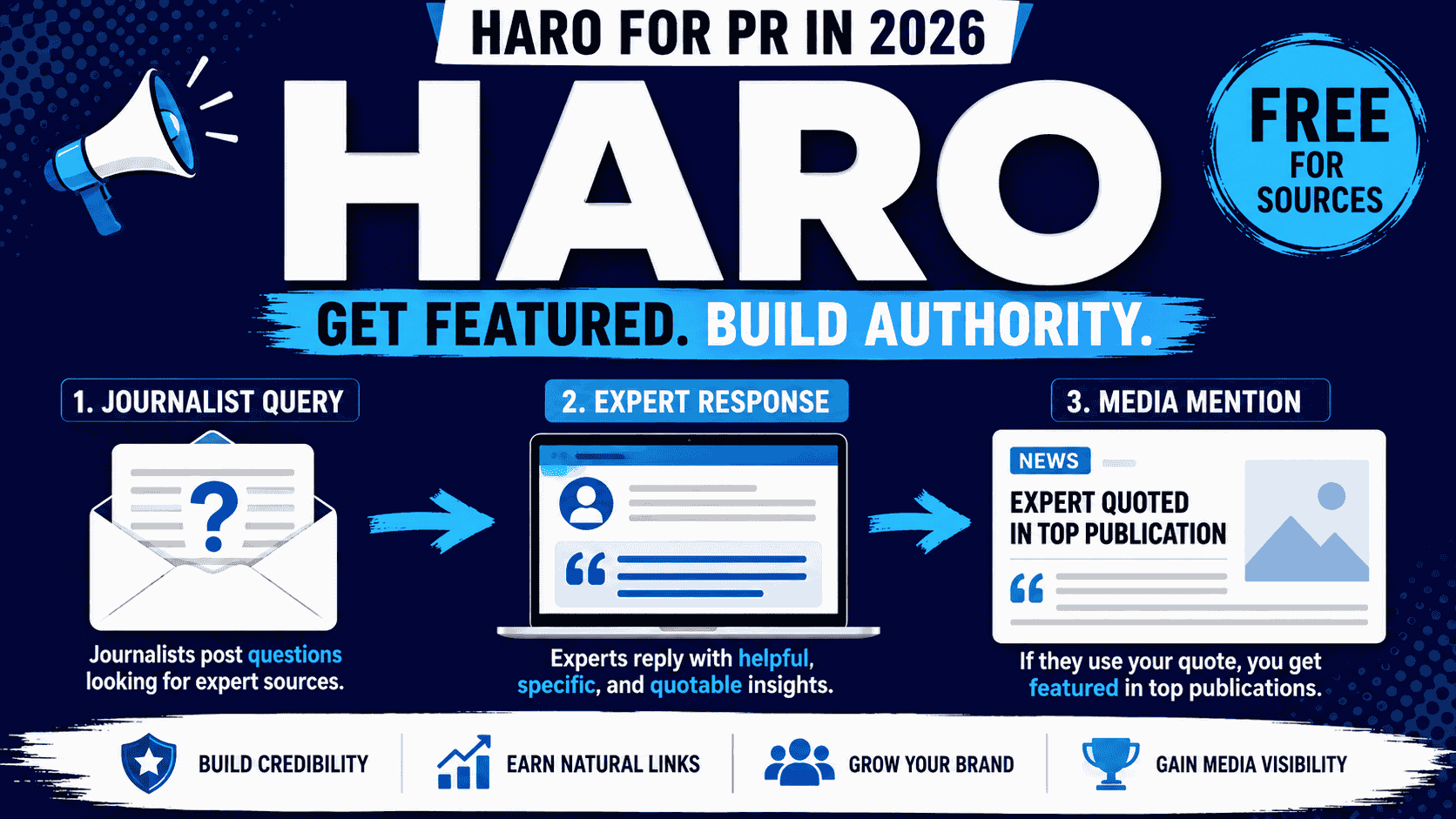
HARO stands for Help a Reporter Out. It is a free service that connects journalists who need expert sources with people who can answer their questions. A journalist posts a query about a topic, you reply with a useful, specific answer, and if they pick your quote, you get named in their article, usually with a link back to your site. If you are brand new to the concept, our complete beginner’s guide to HARO link building breaks down the basics step by step before you dive into the PR angle covered here.
HARO was founded by Peter Shankman and grew into a mailing list with over 800,000 sources and 55,000 journalists. Cision acquired it and eventually retired the HARO name in 2024, running the service under its Connectively brand instead. Connectively shut down for good in December 2024, and Cision sold the HARO platform to Featured.com in April 2025, which relaunched it under the original HARO name that same month.
That relaunch matters for anyone using HARO for PR in 2026. The platform is active again, it is free for sources, and it runs the same three-times-daily email format that made it useful in the first place.
How Does HARO Work Today?
- Sign up as a source at helpareporter.com and pick the categories that match your expertise.
- Receive three digest emails a day, Monday through Friday, packed with journalist queries.
- Scan each query and reply only to the ones you can genuinely answer with specific, first-hand knowledge.
- Send your reply directly to the journalist’s email, following their exact format and deadline.
- Wait. If they use your quote, the article usually goes live within a few days to a few weeks.
- Track which pitches get picked so you can see what is actually working.
Under Featured.com’s ownership, HARO returned to the classic email newsletter format, and journalists’ queries go out in a daily digest to registered experts, with sources replying by email just like before. The new version also scores every pitch for AI usage, and journalists can filter out AI-generated responses or ban accounts that abuse AI to write pitches. That last point is one reason writing your own replies, or at least reviewing and rewriting anything AI drafts, matters more now than it did a few years ago.
HARO for PR vs. HARO for SEO: Key Differences
| Approach | Main Goal | Reply Style | Risk |
| PR-first HARO | Media credibility, brand authority | Specific, quotable, journalist-friendly | Low, reads as genuine expertise |
| SEO-first HARO | Backlink volume | Generic, keyword-stuffed, fast | High, reads as spam and gets ignored |
| Agency-run HARO (no oversight) | Client deliverables | Templated, sent under client’s name | High, client’s name attached to answers they never wrote |
| Founder-run HARO | Both PR and SEO, in that order | Personal, specific, honest about limits | Low, and usually the most sustainable |
Why Use HARO for PR Instead of Just SEO?
Here is my honest opinion after five years of doing this daily: HARO should be used for PR first, not for SEO first. If you only chase links, you start replying to every query you can technically answer instead of the ones you actually know well, and that pushes you toward templated, generic responses. Journalists notice. Editors notice. And eventually your replies stop getting picked at all.
Used for PR, the SEO backlink becomes a side effect of doing something genuinely useful, which is exactly the kind of link Google’s systems trust most. Used only for SEO, HARO becomes one more channel where spam-quality replies drown out real ones, and that hurts everyone, including your own next pitch.
8 Reasons It HARO Still Works in 2026
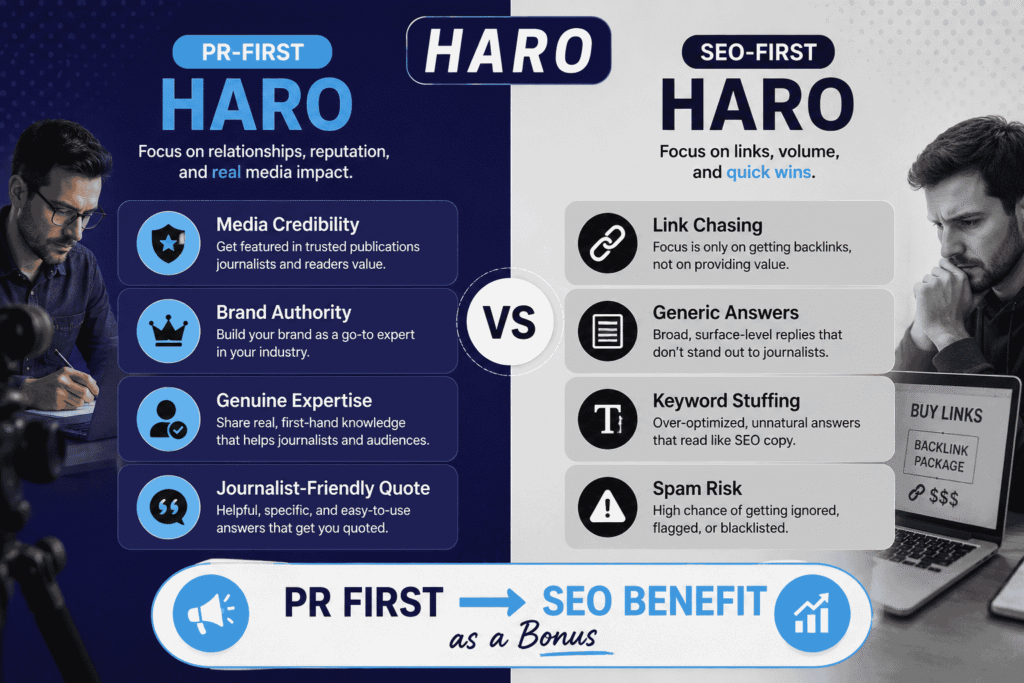
Reason 1: HARO Is Nearly Free
There is no fee to sign up as a source, and HARO remains free in 2026, with no per-placement, per-pitch, or subscription charges under Featured.com’s ownership. The platform makes its money from newsletter sponsors, not from the people replying to queries.
Compare that to a retainer with a traditional PR agency, which often runs into the thousands of dollars a month for a fraction of the media reach you can get by replying to the right queries yourself.
Reason 2: It Gets You Into Outlets You Cannot Buy Your Way Into
Paid placements and sponsored content exist, but they read differently to readers and to Google than an editorial mention does. A journalist choosing your quote because it answered their question is a form of earned media.
Journalists at outlets like Insider, The Wall Street Journal, and Fast Company use these platforms to request expert insight for their stories, and a well-matched quote is what gets chosen. No amount of ad spend replaces that kind of editorial credibility.
Reason 3: It Builds Real Journalist Relationships
Reply well to one journalist’s query and there is a good chance they remember you the next time they cover a related topic.
I have had clients get pulled into follow-up stories months after their first HARO placement because the journalist kept their contact on file. That kind of relationship does not happen with a one-off paid link.
Reason 4: The SEO Backlink Is a Genuine Bonus
When a journalist links back to your site, that link comes from a domain with real trust signals, built over years of publishing. HARO is a way to earn backlinks from high-quality news sites, though the backlink is not always guaranteed, and if you do get one it may carry a nofollow tag that does not directly influence search rankings.
Even a nofollow mention from a trusted outlet still builds brand visibility, and it is exactly the kind of citation that helps a domain look credible to both readers and search engines over time.
What I would push back on is treating that backlink as the whole point. Chase the mention because it is genuinely useful PR, and the SEO value comes along with it.
Reason 5: It Signals Real Expertise, Not Paid Placement
Readers can usually tell the difference between a sponsored quote and a genuine one.
HARO mentions read as the latter because they are: a journalist selected your answer on merit, not because you paid for the slot. That distinction matters more every year as audiences get more skeptical of obviously paid content.
Reason 6: It Works in Small Daily Blocks
You do not need a full-time PR team to make HARO work. Thirty minutes to an hour a day, spent scanning the digest and replying to two or three queries you can genuinely answer well, is enough to build a steady stream of mentions over a few months.
I tell every client the same thing: consistency beats volume here. Five thoughtful replies a week outperform twenty rushed ones.
Reason 7: It Protects You From the Spam Trap
This is the part most guides skip. HARO is a sensitive channel, and if you hand it off to a virtual assistant or a link builder without oversight, you are putting your name and your brand’s credibility on the line for something you never actually wrote. If a reply turns out wrong, controversial, or just low quality, it goes out under your name in a real publication, and that is much harder to walk back than a bad blog post you can quietly edit.
My honest opinion, and I say this as someone who runs HARO for other people professionally: doing your own HARO replies, or at minimum reviewing every single one before it goes out, is the safer and more transparent way to do this. If you do use a VA or an agency, be explicit that nothing gets sent without your review first.
If you read this far and want HARO PR done the right way, without the spam risk described above, get in touch with us and mention this article. We offer a special discount to readers who reach out after finishing this guide.
Reason 8: It Builds a Track Record You Can Reuse
Every placement you earn becomes proof you can point to later, in a media kit, on a bio page, or in a pitch to a bigger outlet. A journalist is more likely to trust a source who has already been quoted by a recognizable publication.
That compounding credibility is the real long-term value of doing HARO consistently rather than in short bursts.
Common Mistakes That Turn PR Into Spam
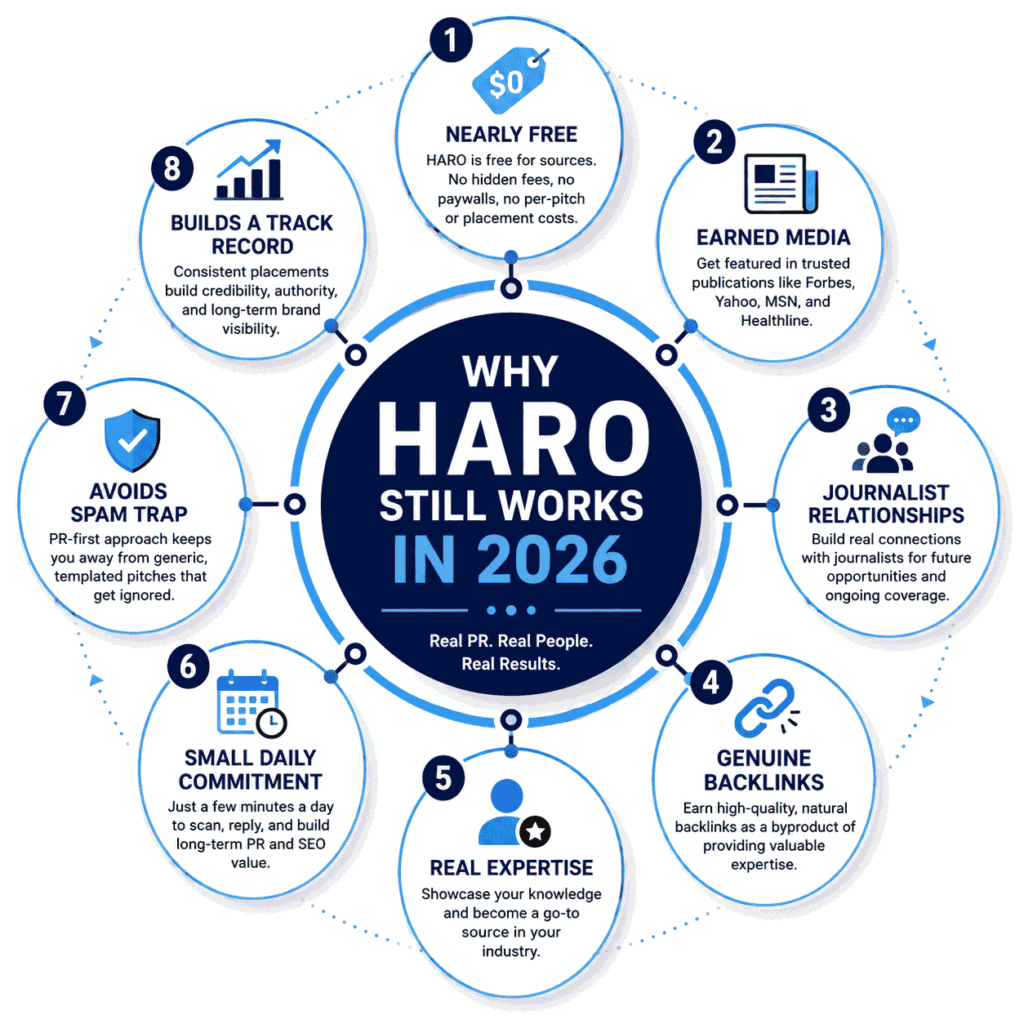
- Replying to every query regardless of fit. This is what pushes HARO from PR into spam territory. Only reply where you have real, specific expertise.
- Sending generic, templated answers. Journalists read dozens of replies per query. A generic answer gets skipped in seconds.
- Outsourcing replies with no review. Your name goes on the final answer. Read it before it goes out.
- Chasing the link instead of the story. A reply written to sound quotable and useful gets picked more often than one written to insert a keyword.
- Ignoring the journalist’s exact format. If they ask for a one-sentence answer and you send four paragraphs, you have already lost the pitch.
- Not tracking what worked. Without a simple log of which pitches got picked, you cannot improve your hit rate over time.
Best Tools for HARO PR Work
| Tool | Best For | Price | Pros | Cons |
|---|---|---|---|---|
| HARO (via Featured.com) | The core query source | Free | Free, large journalist base, classic email format | Volume can be high, requires daily discipline |
| Qwoted | Curated, profile-driven pitching | Free tier, paid tiers available | Leans toward curated, profile-driven workflows favored by business and finance writers | Smaller query volume than HARO |
| MentionMatch (formerly Help a B2B Writer) | B2B-focused queries | Free tier available | Strong fit for SaaS and B2B experts | Narrower niche coverage |
| A simple spreadsheet or Notion tracker | Logging pitches and results | Free | Shows you what is actually converting | Manual upkeep required |
I personally run client HARO workflows through Notion and Gmail so every pitch, reply, and placement is logged in one place. Which tool you use matters less than actually tracking hit rate over time.
Frequently Asked Questions
Is HARO free to use for PR?
Yes. HARO is free for sources under Featured.com, with no per-placement, per-pitch, or subscription charges, since the platform is funded by newsletter sponsors rather than user fees.
How often does HARO send new queries?
HARO emails go out to sources in three batches a day, arriving in the morning, midday, and evening on weekdays.
Do HARO links always help SEO?
Not always directly. A HARO backlink may be nofollow, which does not directly contribute to search rankings, though it can still boost brand reputation. Treat the mention as PR value first and any SEO lift as a bonus.
What happened to HARO in 2024 and 2025?
Cision retired the HARO brand in 2024 in favor of Connectively, then sold the platform to Featured.com in April 2025, which relaunched it under the original HARO name that same month.
Should I use an agency or do HARO myself?
Either can work, but whoever writes the replies should have real expertise on the topic, and nothing should go out under your name without your review. This is a reputational channel, not just a link-building one.
What is a good response rate to expect from HARO?
Response rates vary widely by niche and pitch quality. Focus less on a target percentage and more on replying only where you can add a genuinely specific, useful answer.
Want this Handled for You?
If replying to HARO queries every day sounds like a lot to add to your workload, that is exactly what Almpak does for over 20 clients across health, finance, real estate, legal, SaaS, and crypto. We write or personally review every pitch before it goes out, so you get the PR and SEO benefits above without the spam risk of an unreviewed VA. Contact us here and mention that you read this article for a special discount on your first month.
Final Thoughts
The next time you open a HARO digest, pick one query you could answer better than anyone else replying to it, and write that answer like you are talking to the journalist, not stuffing in a keyword. That single shift, from link-first to story-first, is the difference between an account that gets picked regularly and one that gets ignored.
